

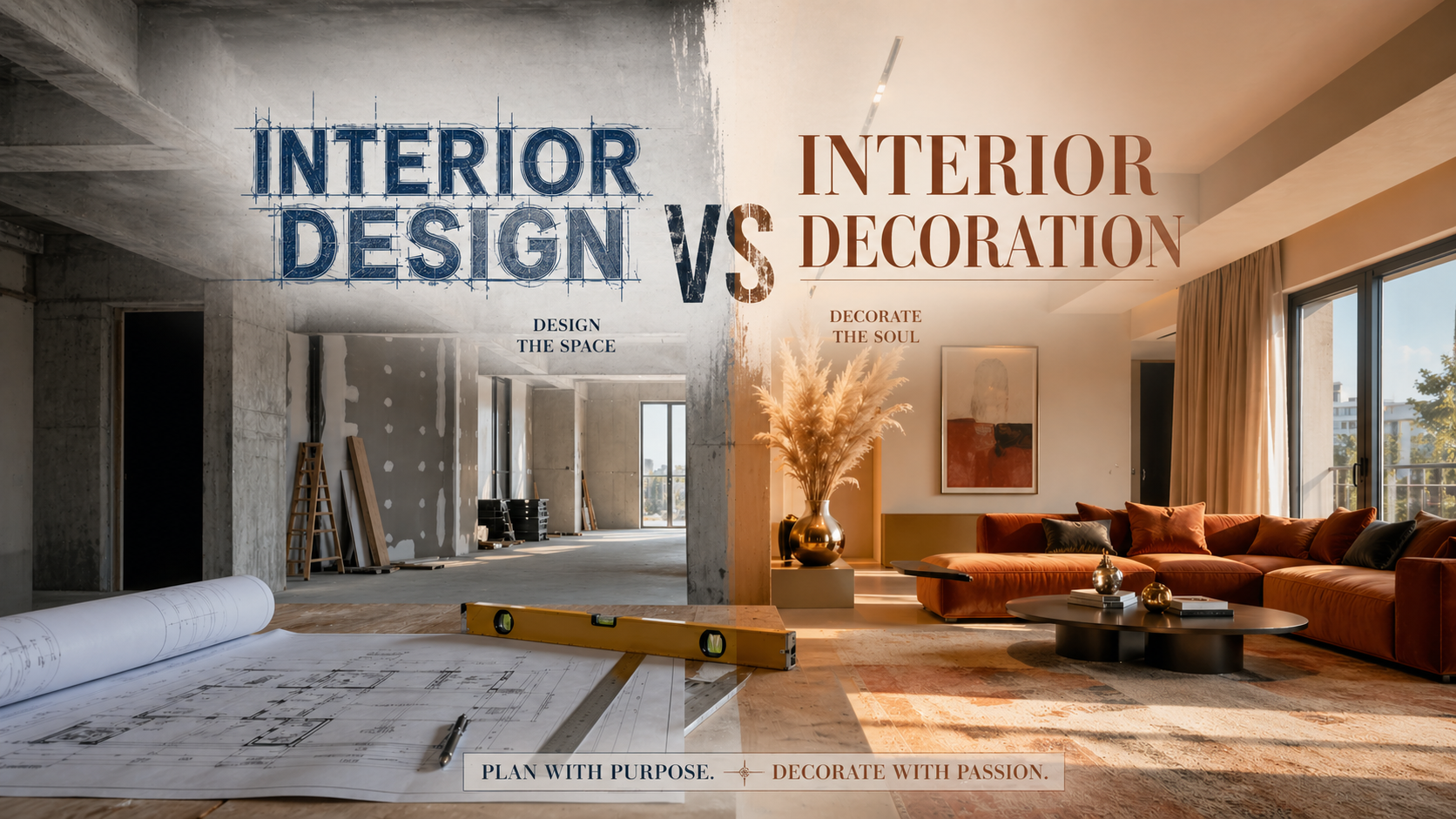
If you’ve started researching a career in interiors, you’ve likely come across the terms “interior design” and “interior decoration” used as though they mean the same thing. They don’t — and the difference between interior design and interior decoration matters quite a lot, both for professionals working in these fields and for anyone trying to hire the right person for the right job.
The confusion is particularly widespread in India, where both terms are often used interchangeably by homeowners, builders, and even some professionals. In practice, though, the two disciplines differ in scope, tools, education requirements, and earning potential — sometimes quite significantly. If you’re a student weighing your career options, or a homeowner planning a renovation and wondering which professional to call, those differences are worth understanding clearly before making any decisions.
This guide breaks down exactly what separates interior design from interior decoration: what each professional actually does day to day, how they’re trained, what they earn, and how to decide which path to pursue if you’re considering the interiors industry as a career. For a broader look at how to enter the profession, you can read our complete guide on how to become an interior designer in India.
What You’ll Learn in This Guide
- Interior design is about structure, space, and function — and begins before construction
- Interior decoration is about aesthetics, furnishings, and finishing — and begins after construction
- Interior designers need a 3–4 year degree; decorators can enter through 1–2 year diploma programmes
- Senior interior designers in India can earn ₹10–19 lakh per annum; decorators vary widely
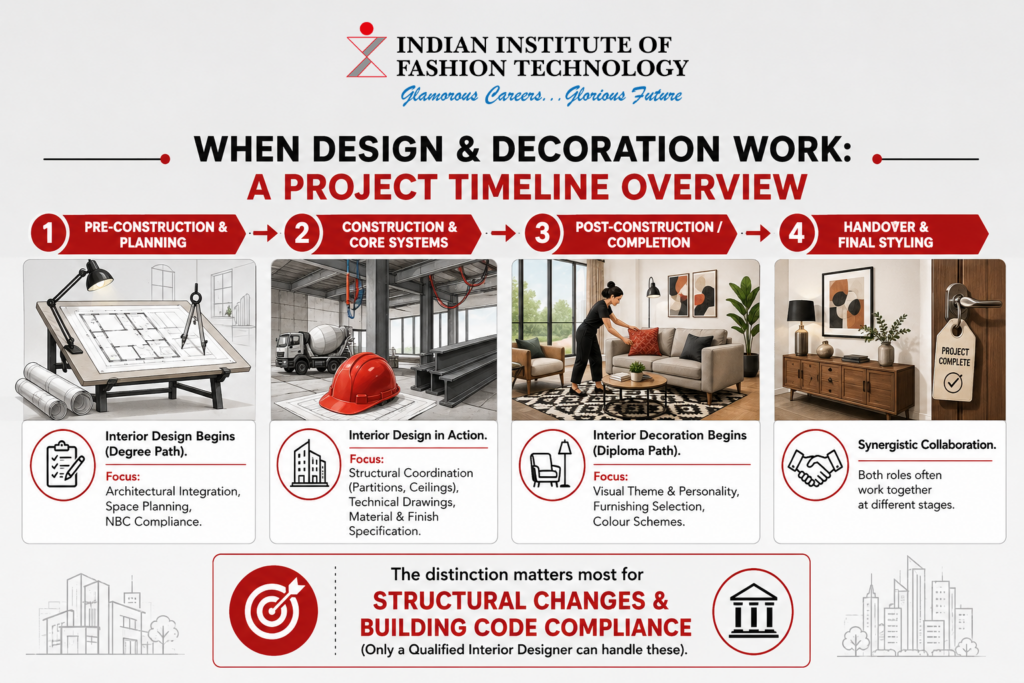
- In most real-world projects in India, both roles work together at different stages
What Is Interior Design?
Interior design is a professional discipline that addresses the creation of safe, functional, and aesthetically coherent interior environments. It begins before walls go up — sometimes before a building is even constructed — and continues until every material, lighting element, and spatial decision has been resolved. An interior designer works at the intersection of architecture, human behaviour, and visual aesthetics.
The scope of what an interior designer handles includes spatial planning, where the goal is to determine how people will move through and actually use a given space. It also includes structural coordination — working alongside architects, civil engineers, and contractors on layout changes, partition walls, door placements, ceiling heights, and flooring systems. In commercial and large-scale residential projects in India, interior designers are also responsible for ensuring that the completed space meets the requirements of the National Building Code (NBC) and applicable local municipal regulations. A decorator, by contrast, does not take on these compliance responsibilities.
Beyond structure, interior designers handle material and finish specification — choosing the right materials for walls, flooring, ceilings, and fixtures based on durability, aesthetics, budget, and safety requirements. They design lighting systems that balance natural and artificial sources. And while furniture is certainly part of the picture, an interior designer integrates it into an overall spatial plan from the beginning rather than adding it at the end.
In India, an interior designer typically holds a B.Des (Bachelor of Design) or B.Sc in Interior Design from a recognised institution — a 3 to 4-year degree programme that covers spatial design, building materials, technical drawing, computer-aided design (CAD), ergonomics, furniture design, and project management. According to data published by Careers360 in 2026, interior designers in India can expect to earn between ₹3.21 lakh and ₹7.5 lakh per year at entry to mid level, with experienced practitioners earning between ₹10 lakh and ₹19 lakh per annum depending on specialisation, project type, and location.
To understand the foundational principles that guide how interior designers approach a space, our article on the fundamentals of interior design principles covers those concepts in detail.
What Is Interior Decoration?
Interior decoration is the practice of enhancing an existing space through the thoughtful selection and arrangement of furnishings, colour, textiles, artwork, accessories, and decorative finishes. Where an interior designer shapes the architecture of a space, a decorator shapes its personality. The structural bones are already in place when a decorator steps in — their job is to bring that space to life.
An interior decorator selects furniture, upholstery, rugs, curtains, and soft furnishings. They advise on colour schemes and paint finishes. They curate artwork, mirrors, and decorative accessories. They develop a visual theme for a space — whether that’s warm and rustic, clean and minimalist, or something that nods to a particular cultural or design tradition — and then source and procure the elements needed to achieve it. Managing vendor relationships and delivery schedules is part of the job too, particularly on larger residential projects.
What a decorator does not do is just as important to understand. A decorator does not prepare technical drawings or architectural plans. They cannot advise on load-bearing walls or structural configurations. They are not qualified to ensure compliance with India’s National Building Code, and they typically do not work with contractors on construction-related decisions. If your project involves reconfiguring a room layout, opening up walls between spaces, or changing plumbing or electrical routing, those decisions fall outside a decorator’s professional scope.
Entry into interior decoration in India is typically through a 1 to 2-year diploma programme. Some practitioners enter through shorter certificate courses or self-directed learning, though formal training provides clearer market credibility and a more structured skill foundation. According to ITM University’s Interior Design Salary data from 2026, interior decorators in India earn an average of ₹3 lakh to ₹3.41 lakh per year at entry level, with experienced specialists and niche stylists reaching considerably more.
There is one clear rule of thumb worth remembering: an interior designer can also decorate — most do, and it’s a natural part of completing any project. But an interior decorator cannot design in the architectural-technical sense of the word. The distinction runs one way.
Interior Design vs Interior Decoration: A Side-by-Side Comparison
Listing the differences in prose can sometimes make it harder to compare directly. The table below places both disciplines side by side across the dimensions that matter most — whether you’re trying to choose a career path or decide which professional to hire for a project.
| Dimension | Interior Design | Interior Decoration |
|---|---|---|
| Primary focus | Space planning, function, and structure | Aesthetics, styling, and finishing touches |
| Structural changes | Yes — walls, layouts, electrical, plumbing | No — works within the existing structure |
| Building code knowledge | Required for commercial and large residential projects | Not required |
| Technical drawings | Yes — floor plans, elevation drawings, 3D renders | No |
| Education required | B.Des / B.Sc in Interior Design (3–4 years) | Diploma in Interior Design/Decoration (1–2 years) |
| Professional collaboration | Architects, civil engineers, contractors | Vendors, furniture suppliers, clients |
| Project entry point | Pre-construction or full renovation planning | Final stage — after construction is complete |
| Entry-level salary in India | ₹3.21 lakh–₹5 lakh per annum | ₹3 lakh–₹3.41 lakh per annum |
| Senior earning potential in India | ₹10 lakh–₹19 lakh+ per annum | Varies — niche specialists can earn well |
| Best suited for | New builds, full renovations, commercial fit-outs | Refreshing or restyling a completed space |
| Bottom line | Choose this when your project involves structure, layout, or code compliance | Choose this when your space is done and needs a visual lift |
Sources: Careers360 Interior Designer Salary Report 2026; ITM University Interior Design Salary Blog 2026.
Where the Lines Blur: The Real-World Overlap in India
Most articles that explain the difference between interior design and decoration present the two as clearly separate tracks. In practice — especially in the Indian residential market — the situation is messier, and understanding the overlap is just as important as understanding the distinction.
On a typical new-build apartment project in a city like Bangalore, the work often unfolds in two stages. In the first stage, an interior designer is brought in to plan the space: deciding where partition walls go, where electrical points and light switches are positioned, how the kitchen work triangle is laid out, and how movement flows from the entrance into the main living areas. Once the structural and technical decisions are locked and construction is complete, the second stage begins — and this is typically where a decorator (sometimes the same person wearing a different hat, sometimes a separate professional) steps in to handle the furniture, textiles, colour choices, and final styling.
The challenge in India is that the two terms are used almost interchangeably by clients, builders, and even in job postings. This is documented in industry commentary: a 2025 analysis by Infurnia, a design industry platform, described India’s interior design sector as “largely unorganized,” with pricing that is not standardised and varies dramatically depending on the vendor, city, and project scope. In this environment, a homeowner might engage a decorator for a job that actually requires design-level input, or hire a designer for simple restyling work that could have been handled more affordably by a decorator.
The practical consequence of this confusion, noted in Quora discussions among Indian homeowners, is that clients sometimes end up with a space that looks visually appealing but has underlying functional or structural problems — because the wrong professional was engaged at the wrong stage of the project.
There’s also the question of overlap at the practitioner level. Many working professionals in India perform tasks from both disciplines, depending on the project. An interior designer might handle all the decoration decisions on a small residential job. A decorator with significant experience might have developed enough knowledge to advise on minor layout adjustments, though they would not formally be responsible for structural decisions. This fluidity is real, but it doesn’t make the underlying distinction any less meaningful.
Education Paths: Choosing Between Interior Design and Decoration
If you’re a student in India considering a career in interiors, the qualification you pursue will largely determine the scope of work available to you — and how long it takes to get there.
For interior design, the standard qualification is a B.Des or B.Sc in Interior Design from a recognised institution. These are typically three to four-year full-time degree programmes. The curriculum covers spatial design, building materials, lighting, CAD software, furniture design, ergonomics, and project management, along with the technical drawing skills that underpin all design-level work. Admission is generally through design entrance examinations such as NID DAT, NIFT, or institute-specific tests, though some universities accept Class 12 merit scores directly. Students who complete a B.Des or B.Sc can go on to work with architecture firms, real estate developers, hospitality groups, retail brands, or establish independent practices. Whether you pursue interior design or interior decoration, knowing which software tools are standard in Indian interior design practice will help you build a job-ready skill set from day one.
For interior decoration, a one to two-year diploma in interior design and decoration is typically the entry qualification. Diploma programmes concentrate on the aesthetic dimensions of interior work — colour theory, furniture selection and arrangement, fabric and material styling, and vendor management — rather than technical drawing or building systems. Shorter certificate programmes and online courses are also available, though these are generally suited to supplementing existing skills rather than building a primary professional credential.
The practical difference is straightforward: a degree-qualified interior designer can take on the full scope of a project from initial concept to handover. A diploma-holding decorator works at the finishing stages of a project with a narrower but still genuine range of responsibilities.
Our detailed guide to interior design courses after 12th in India covers the main degree and diploma programmes currently available, along with eligibility requirements and fee structures. For students considering a B.Sc specifically, our article on what to expect from a B.Sc in Interior Design in India goes through the curriculum and career outcomes in detail.
Common Mistakes When Navigating the Design vs Decoration Divide
A few patterns of confusion come up repeatedly — among homeowners hiring for projects and among students choosing an education path. These are worth flagging directly.
Hiring a decorator for a structural project. This is probably the most expensive mistake on the client side. If a project involves removing a wall, reconfiguring a kitchen, adding a bathroom, or changing the electrical routing of a flat, those decisions require a qualified interior designer. A decorator simply cannot take on that scope of responsibility — not as a limitation of skill, but as a matter of professional and technical boundaries. Realising mid-project that you need a designer after a decorator has already begun can mean delay, additional cost, and in some cases having to redo completed work.
Treating a decoration diploma as equivalent to a design degree. Students who want the full range of professional options — including commercial projects, employment at architecture firms, and the ability to handle structural briefs — need degree-level credentials. A diploma is a legitimate and useful qualification for decoration-level work, but it won’t open the same doors. Understanding the distinction before choosing a programme saves significant time and money.
Undervaluing what decoration actually is. Interior decoration is a specific and demanding skill set. Getting colour, proportion, texture, pattern, and object selection right — in a way that makes a space genuinely liveable and visually coherent — takes real ability. The fact that it doesn’t involve structural drawings doesn’t make it less sophisticated. It simply makes it different.
Using the terms interchangeably in professional contexts. In a job interview, a client presentation, or an academic setting, conflating interior design with interior decoration signals a lack of professional awareness. Precision in language matters in both fields.
Which One Is Right for You? A Practical Decision Framework
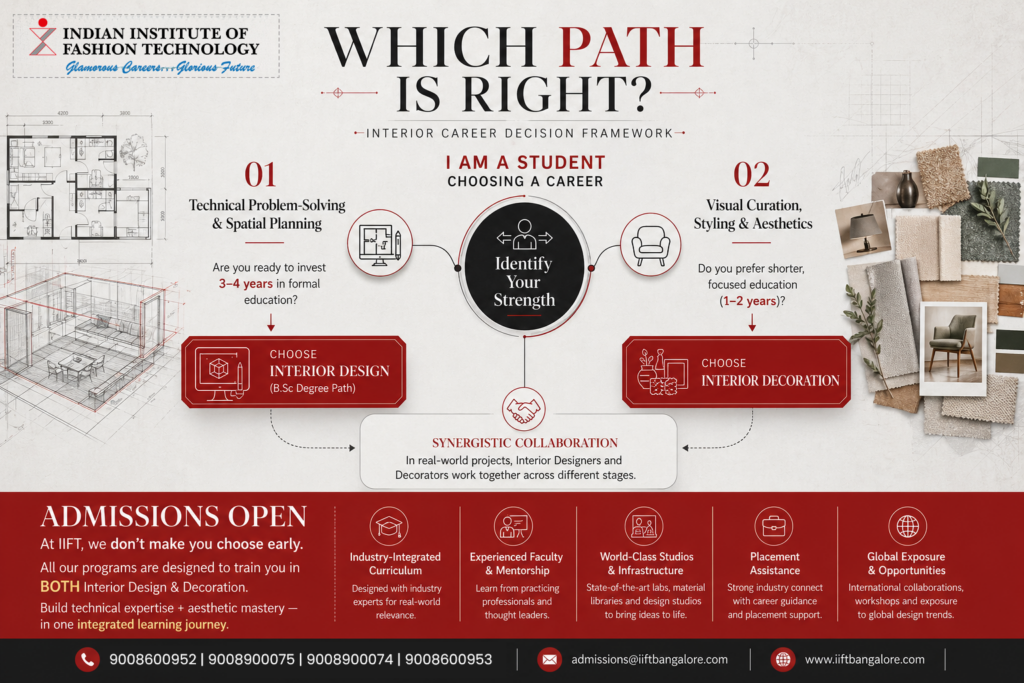
If you’re at the point of choosing between an interior design degree and a decoration diploma, these five questions tend to clarify things quickly.
1. Do you enjoy technical problem-solving? Interior design involves spatial logic, building systems, and technical documentation. If learning CAD software, working through how a room’s electrical plan connects to its lighting design, or coordinating across architects and contractors sounds engaging rather than daunting, design is likely the right direction.
2. Is your strength in visual curation? If what excites you is finding the right piece of furniture for a room, developing a colour palette that changes how a space feels, or sourcing textiles and objects that come together into a coherent interior, decoration may suit your particular abilities better.
3. What types of projects do you want to work on? Commercial interiors — offices, hotels, restaurants, retail spaces — almost always require a qualified interior designer because of code compliance requirements. Residential styling, home staging, and set decoration are domains where decorators work effectively and independently.
4. How long can you commit to studying? A B.Des programme is a three to four-year commitment. If entering the field faster matters to you, a diploma gets you there in one to two years — though with a narrower scope of professional work on the other side.
5. What earning trajectory matters to you? Senior interior designers in India can earn ₹10 lakh to ₹19 lakh or more per annum, according to Careers360’s 2026 salary data. The decoration route can also reward experienced specialists well, but the typical floor and ceiling are lower than on the design side.
At IIFT Bangalore, the B.Sc in Interior Design and Decoration programme is structured to give students grounding in both disciplines — from spatial planning and technical drawing through to furniture specification and styling — so graduates can work across a wide range of professional environments. If you’re weighing how to enter the field, our guide on how to start a career in interior design covers the practical steps, and our overview of the scope of interior designing in India addresses where the industry is headed and what opportunities currently exist.
Frequently Asked Questions
What is the main difference between interior design and interior decoration?
Interior design addresses the structural, spatial, and functional dimensions of an interior space — including layout planning, building code compliance, and coordination with architects and contractors. Interior decoration focuses on the aesthetic finish of a completed space: furniture, colour, textiles, and accessories. The simplest way to remember it is that a designer shapes how a space works; a decorator shapes how it looks.
Can an interior decorator make structural changes to a space?
No. Structural changes — removing or adding walls, changing door placements, reconfiguring plumbing or electrical systems — fall outside the scope of interior decoration. These decisions require a qualified interior designer with the technical training to assess safety, prepare construction drawings, and ensure compliance with applicable building codes including India’s National Building Code.
Do interior designers also do decoration?
Yes, most interior designers handle decoration as part of a complete project. Once structural and spatial decisions are finalised, the designer typically oversees furniture, finish, and styling choices as well. The reverse is not true: interior decorators do not take on design-level responsibilities.
Which earns more in India — an interior designer or an interior decorator?
Interior designers generally have a higher earning ceiling. According to Careers360’s 2026 salary data, senior interior designers in India can earn between ₹10 lakh and ₹19 lakh per annum. Interior decorators at entry level earn an average of ₹3 lakh to ₹3.41 lakh per year (ITM University, 2026), though experienced specialists and niche stylists can earn considerably more. Both fields reward experience and a strong portfolio.
What qualifications do I need to become an interior designer in India?
The standard qualification is a B.Des (Bachelor of Design) or B.Sc in Interior Design from a recognised institution — a three to four-year degree programme. These programmes cover spatial design, building materials, CAD, technical drawing, lighting, and project management. For interior decoration, a one to two-year diploma is the typical entry qualification. Admission to degree programmes is usually through design entrance exams such as NID DAT, NIFT, or institute-specific tests.
Why are interior design and interior decoration often confused in India?
The confusion is partly a market structure issue. India’s interior design sector has been described as largely unorganized, with non-standardized pricing and inconsistent use of professional titles across the industry. Both terms are frequently used interchangeably in job postings, client briefs, and informal conversations — even though they refer to distinct professional disciplines with different scopes of work, education requirements, and technical responsibilities.
When should I hire an interior designer vs an interior decorator?
Hire an interior designer if your project involves structural changes, new construction, full renovation, commercial fit-out, or anything that requires compliance with building codes. Hire an interior decorator if your space is already built and you want help with furniture, colour, styling, and finishing. For larger residential projects, it’s common in India to use both professionals at different stages of the same project.
Is interior decoration a good career in India?
Yes, decoration is a viable and growing career path in India, driven by rising consumer spending on home interiors and increasing demand from the real estate, hospitality, and retail sectors. It offers a faster entry into the workforce than a four-year design degree. That said, the field has a narrower technical scope than interior design, which affects the types of projects available and the long-term earning trajectory for most practitioners.
This article was written by the academic team at IIFT Bangalore, a design institution offering degree and diploma programmes in fashion design, interior design, and apparel management. IIFT’s Interior Design faculty includes practicing professionals with experience across residential, commercial, and hospitality projects. The salary and industry data cited in this article are drawn from publicly available sources including Careers360’s 2026 salary reports, ITM University’s 2026 interior design salary blog, and Infurnia’s 2025 interior design industry analysis.
Pulling It Together
Interior design and interior decoration are related but genuinely distinct fields. Interior design encompasses the structural, functional, and technical dimensions of an interior — work that begins at the planning stage, requires formal degree-level education, and involves coordination across architects, contractors, and engineers. Interior decoration focuses on the aesthetic finish of a completed space — furniture, colour, textiles, and accessories — and is accessible through shorter diploma programmes.
In practice, especially on residential projects in India, the two roles often operate on the same project at different stages. The distinction matters most when a project involves structural changes, building code compliance, or technical documentation — tasks that only a qualified interior designer can take on. For a space that is already built and needs a visual transformation, a skilled decorator is often the right call.
For students choosing between the two career paths, the decision comes down to whether your strengths and interests lie in technical problem-solving and spatial planning or in visual curation and styling — and how much time you’re willing to invest in formal education before entering the field. If you’re ready to explore what studying interior design looks like in practice, our article on why to study interior design and decoration is a good next step.



Discussion