

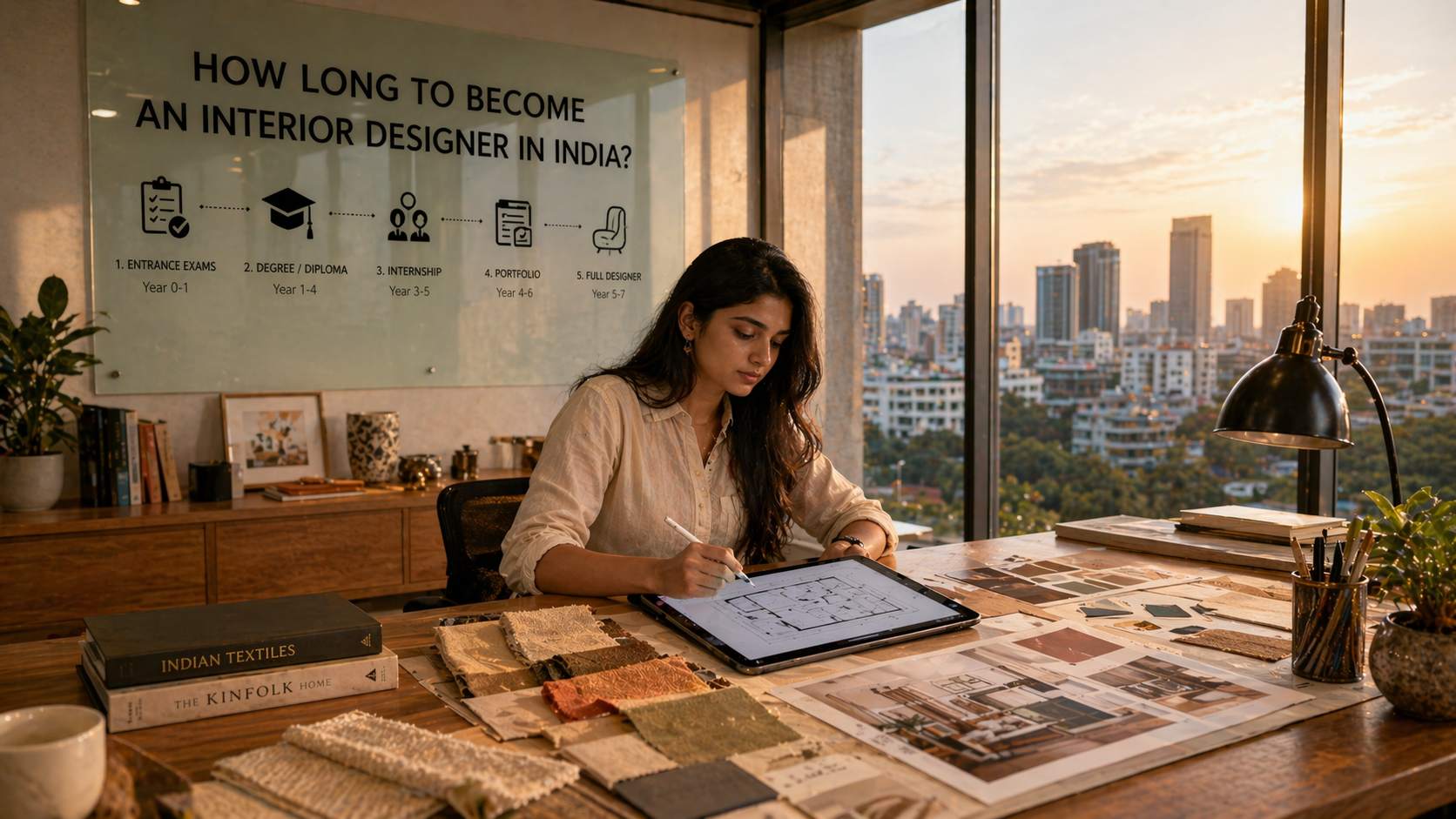
How Long Does It Really Take to Become an Interior Designer in India?
The short answer is 3 to 7 years — but the actual number depends entirely on the path you pick, where you study, and how quickly you build real-world skills beyond the classroom. A diploma holder who interns aggressively can start taking on freelance projects within 2 years of finishing Class 12. Someone pursuing a 4-year B.Des followed by a master’s degree might not be fully independent until 7 or 8 years later. Neither path is wrong; they just lead to different starting points in the industry.
India’s interior design market was valued at USD 36.89 billion in 2025, according to IMARC Group, and is projected to reach USD 74.73 billion by 2034 at a CAGR of 8.16%. That growth means there is genuine demand for trained designers — but “trained” does not always mean “four-year degree holder.” Understanding the realistic timelines for each route helps you plan better, spend less where possible, and enter the workforce at the right moment. If you are exploring how to become an interior designer in India, this breakdown will give you the specifics that most guides skip over.
What Does “Becoming an Interior Designer” Actually Mean?
Before counting years, it helps to define what “becoming” means in this context. In India, interior design is not a licensed profession — there is no government-mandated license required to practice, unlike architecture where registration with the Council of Architecture is compulsory under the Architects Act, 1972. This is a detail that almost every career guide leaves out or buries in a footnote.
What this means practically: you can legally call yourself an interior designer and take on clients the moment you feel competent enough to do so. There is no board exam, no registration hurdle, and no minimum number of supervised practice hours mandated by law.
However, credibility matters. Clients — especially commercial and corporate ones — look for formal qualifications. The Indian Institute of Interior Designers (IIID) offers voluntary professional membership that adds credibility, but it is not a legal requirement. You will also need a GST registration and business registration if you plan to run a firm, but those are standard business formalities, not design-specific licenses.
So when we talk about “how long it takes,” we are really asking: how long until you have the education, the software skills, the portfolio, and enough practical experience to land paying projects consistently?
The Five Routes and Their Timelines
There is no single path to becoming an interior designer in India. Here are the five most common routes, each with a different time commitment, cost structure, and career outcome. The table below puts them side by side before we dig into the details.
| Route | Duration | Approximate Fees | Entry Requirement | Best For |
|---|---|---|---|---|
| Certificate / Short-Term Course | 6–12 months | ₹30,000–₹1.5 lakh | Class 10 or 12 pass | Career changers, hobbyists wanting to freelance |
| Diploma | 1–2 years | ₹50,000–₹3 lakh | Class 12 pass | Quick entry into assistant roles or freelance work |
| B.Sc. in Interior Design | 3 years | ₹2–₹6 lakh (total) | Class 12 pass (any stream) | Balanced depth without the 4-year commitment |
| B.Des in Interior Design | 4 years | ₹5–₹20 lakh (total) | Class 12 pass + national-level entrance exam | Students aiming for top design firms or academia |
| Master’s (M.Des / M.Sc.) | 1.5–2 years (after UG) | ₹3–₹10 lakh (total) | Bachelor’s degree + entrance exam | Specialisation in sustainable design, furniture design, or lighting |
Verdict: For most students finishing Class 12 who want a solid career foundation without overinvesting in time, the 3-year B.Sc. in Interior Design hits the right balance. It is shorter than a B.Des, more respected than a diploma by employers, and accepted across the industry. The 4-year B.Des makes sense primarily if you clear a top national-level entrance exam and can attend a government-funded design institute.
Year-by-Year Breakdown: What Each Stage Looks Like
Most guides list course durations and stop. But a degree alone does not make you job-ready. Here is what the full timeline actually looks like when you factor in entrance exam preparation, the course itself, internship time, software skill building, and the initial freelance or employment phase.
Stage 1: Entrance Exam Preparation (3–12 months before the course starts)
If you are targeting top government-funded design institutes that admit through national-level entrance exams, you will need 6 to 12 months of focused preparation. These exams are typically held between December and April each year, and they test drawing ability, spatial reasoning, observation, material sensitivity, and general awareness — not just textbook knowledge.
For private institutes and state-level colleges, some require their own entrance tests while many admit based on Class 12 marks and a portfolio or interview. Preparation time for these is shorter — roughly 1 to 3 months.
Important detail that most guides miss: you do not need to have studied Mathematics in Class 12 to pursue interior design. Most interior design courses in India accept students from Arts, Commerce, or Science streams, making the field more accessible than architecture.
Stage 2: The Course Itself (1–4 years depending on route)
This is the core educational phase. During a B.Sc. or B.Des program, you will study design fundamentals (colour theory, space planning, material science, lighting design), technical drawing, building construction basics, design history, and professional practice. The later semesters typically include specialised electives — sustainable design, furniture design, exhibition design, or commercial interiors.
A critical part of this stage that determines your actual readiness is software proficiency. Industry-standard tools include AutoCAD (for 2D drafting), SketchUp (for 3D modelling), 3ds Max or V-Ray (for rendering), and Revit (for BIM workflows). SketchUp is relatively quick to pick up — you can learn the basics within a few weeks of consistent practice. AutoCAD has a steeper learning curve and typically requires 2 to 3 months of dedicated training to use efficiently. Most degree programs integrate software training into the curriculum, but diploma and certificate courses may cover only the basics, requiring you to self-learn the rest. For a detailed guide to which tools matter at each stage — with free student licensing options — see our overview of the best software for interior designers in India.
Stage 3: Internship (2–6 months, usually overlapping with the final year)
Almost every reputable interior design program in India includes a mandatory internship component, typically lasting 2 to 6 months. According to Careers360, interns are involved in space planning, sourcing materials, CAD drawings, creating mood boards, and client presentations.
This stage is where you bridge the gap between academic knowledge and professional practice. You learn things no classroom teaches — how to handle client revisions, coordinate with contractors, manage material procurement delays, and work within real budgets. The firms you intern at often become your first employers or referral sources, so choosing the right internship matters more than most students realise.
Stage 4: First Professional Year (12 months after course completion)
Your first year as a working designer — whether employed at a firm or freelancing — is effectively still a learning phase. You will make mistakes with material estimates, undercharge for projects, and learn that managing a contractor is half the job. This is normal and necessary. Most designers consider themselves genuinely competent after completing at least 5 to 10 real projects end-to-end.
The Total Time for Each Path — Honestly Calculated
When you add up all stages — exam prep, the course, internship, and the initial professional settling-in period — the real timeline looks different from just the course duration printed on a brochure.
| Path | Exam Prep | Course Duration | Internship | First Professional Year | Total Time to Be “Job-Ready” |
|---|---|---|---|---|---|
| Certificate course | 0 months | 6–12 months | 0–3 months | 12 months | ~1.5–2 years |
| Diploma | 0–3 months | 1–2 years | 2–4 months | 12 months | ~2.5–3.5 years |
| B.Sc. Interior Design | 1–3 months | 3 years | 3–6 months | 12 months | ~4–5 years |
| B.Des Interior Design (government institutes) | 6–12 months | 4 years | Built into course | 12 months | ~5.5–6.5 years |
| B.Des + M.Des | 6–12 months | 4 + 2 years | Built into course | 6–12 months | ~7–8 years |
These are honest estimates. If someone tells you that you can become a fully independent interior designer in 6 months, they are either selling a course or redefining what “interior designer” means. You can start assisting or doing very small residential projects after a short course, but handling commercial or institutional projects independently takes years of accumulated knowledge.
Can You Become an Interior Designer Without a Full Degree?
Yes — and this is actually more common in India than the brochures suggest. Since there is no mandatory licensing, many working interior designers entered the field through diploma courses, online certifications, or even self-study combined with apprenticeship under an established designer.
The tradeoff is real, though. According to CollegeDunia, opportunities from corporate and institutional clients are “comparatively significantly less” without a degree. A diploma or certificate holder will find it easier to start as a freelancer serving residential clients — home renovations, apartment interiors, kitchen redesigns — than to land a position at a large design firm that typically requires a minimum bachelor’s degree.
Institutions like IIFT Bangalore offer a 6-month diploma in interior designing specifically designed for career changers and people who want to enter the field without committing to a 3 or 4-year degree. There is also a 1-year weekend course for working professionals who want to transition into interior design without leaving their current job.
The practical strategy that works best for non-degree holders: build a portfolio fast by taking on small projects (even free or discounted ones for friends and family), document every project with before-and-after photographs, and learn the software tools independently. A strong portfolio often matters more to residential clients than a degree certificate.
What Most Career Guides Get Wrong About the Timeline
After reviewing the top-ranking articles on this topic, there are several things that most of them either skip entirely or get wrong. These are worth knowing before you commit to a specific path.
They confuse course duration with career readiness. Getting a degree or diploma is not the finish line. The scope of interior designing in India is broad, but competence takes practice. A 3-year B.Sc. graduate still needs 6 to 12 months of internship and initial work experience before they can independently manage a project from concept to execution.
They do not mention that India has no interior design license. This is a significant piece of information. Unlike architecture (regulated by the Council of Architecture) or medicine, you do not need to pass a board exam or register with a government body to practice interior design in India. IIID membership is voluntary and professional, not regulatory. This means the barrier to entry is lower than most articles suggest — which can be both an opportunity and a challenge, since the market has practitioners with varying levels of skill.
They underestimate software learning time. Knowing design theory but being unable to produce professional AutoCAD drawings or 3D renders makes you unemployable in 2026. Budget at least 3 to 6 months of serious software practice alongside or after your course, unless your program covers it thoroughly.
They ignore the emerging green design certification advantage. The IGBC (Indian Green Building Council) offers a specific Green Interiors certification, and GRIHA — developed by TERI and adopted by the Ministry of New and Renewable Energy — is becoming increasingly relevant. For government-funded projects, GRIHA or IGBC certification knowledge is becoming a differentiator. Adding this specialisation takes about 3 to 6 months of additional study but can significantly accelerate career growth, particularly in commercial and institutional design.
Salary Expectations Based on Timeline
Your earning potential in interior design correlates directly with how much time you have invested in education and practical experience. Here is what the numbers look like, based on 2025-2026 data from PayScale, Indeed India, and Careers360:
A fresher straight out of a diploma or degree program earns between ₹15,000 and ₹30,000 per month, which works out to roughly ₹2.5 to ₹4 LPA (lakhs per annum). After 3 to 5 years of experience, the range moves to ₹40,000 to ₹80,000 per month (₹5 to ₹10 LPA). Senior designers and studio heads with 8 or more years in the field can earn ₹1 lakh to ₹2.5 lakh per month.
City matters. According to Indeed India, Mumbai, Delhi, and Bangalore offer salaries 20 to 35% higher than Tier-2 and Tier-3 cities due to higher-profile clients and larger project budgets. Pune and Hyderabad are also growing as design hubs.
Freelancing is where the real earning potential lies for experienced designers. Well-established freelancers with a strong portfolio and client network report monthly earnings of ₹50,000 to ₹1 lakh or more, with some high-end residential and commercial projects commanding fees of several lakhs per project. However, freelancing income is irregular in the first 2 to 3 years — most designers who freelance successfully have at least 3 years of firm experience first.
Common Mistakes That Add Unnecessary Years to Your Timeline
Spending too long preparing for entrance exams without a backup plan. Acceptance rates at government design institutes are extremely low. If you spend 12 months preparing and don’t clear the exam, you have lost a year. Always apply to private institutes like IIFT Bangalore simultaneously so you have a parallel option — IIFT’s B.Sc. in Interior Design admits based on merit and a portfolio review, with no national-level entrance exam required.
Choosing a course based on duration alone. A 6-month certificate might seem appealing, but if it doesn’t cover software training, you will spend another 3 to 6 months learning AutoCAD and SketchUp separately. Factor total time including upskilling, not just the course brochure duration.
Skipping internships or treating them as formalities. An internship at a busy design firm teaches you more in 3 months than the last semester of most courses. Treat it as a job audition, not a checkbox.
Waiting for the “perfect” first job. Your first role in interior design will probably not be glamorous. You might be doing site measurements, material sourcing, or AutoCAD cleanup for a senior designer. This grunt work is where you learn the operational side of the business that no course covers — contractor management, vendor negotiations, budget tracking, and client expectations.
Not building a portfolio during the course. Every academic project, every assignment, every internship project should be documented. By the time you graduate, you should have a presentable portfolio of at least 8 to 10 projects. Students who neglect this end up spending 3 to 6 additional months after graduation building one from scratch.
Author
This guide was compiled by the academic team at IIFT Bangalore, an institution offering specialised interior design programs ranging from 6-month diplomas to full B.Sc. degrees. IIFT’s interior design curriculum is developed in consultation with practising designers and covers both traditional design fundamentals and current industry tools including AutoCAD, SketchUp, and 3ds Max.
Frequently Asked Questions
How many years does it take to complete an interior design course in India?
It depends on the course level. Certificate programs take 6 to 12 months, diploma programs take 1 to 2 years, a B.Sc. in Interior Design takes 3 years, and a B.Des takes 4 years. A master’s degree (M.Des or M.Sc.) adds another 1.5 to 2 years after the bachelor’s. Most students pursuing a bachelor’s route spend 3 to 4 years in formal education.
Can I become an interior designer after 12th without an entrance exam?
Yes. Many private institutes and universities admit students directly based on Class 12 marks, a portfolio review, or an institutional entrance test. National-level entrance exams are only required for specific government-funded design institutes. You can pursue diploma or B.Sc. programs at private institutions like IIFT Bangalore without clearing any such exam.
Is a degree mandatory to work as an interior designer in India?
No. India does not have a mandatory licensing requirement for interior designers, unlike architecture. You can legally practice without a degree. However, a formal qualification significantly improves your credibility with clients and your chances of getting hired at established design firms. Corporate and institutional clients almost always prefer degree holders.
What is the salary of a fresher interior designer in India?
According to data from PayScale and Indeed India (2025-2026), fresher interior designers earn between ₹15,000 and ₹30,000 per month, which translates to approximately ₹2.5 to ₹4 LPA. Salaries are higher in metro cities like Mumbai, Delhi, and Bangalore — typically 20 to 35% more than Tier-2 cities.
Do I need to study Mathematics to pursue interior design?
No. Most interior design courses in India accept students from any stream — Arts, Commerce, or Science. Mathematics is not a mandatory subject for admission to interior design programs, which is different from architecture where maths and physics are typically required at the Class 12 level.
How long does it take to learn interior design software like AutoCAD and SketchUp?
SketchUp basics can be picked up within 2 to 4 weeks of regular practice due to its intuitive interface. AutoCAD has a steeper learning curve and typically takes 2 to 3 months of dedicated practice to reach a professional level. Advanced rendering software like 3ds Max or V-Ray requires an additional 2 to 3 months. Many degree programs include software training, but diploma and certificate courses may require you to learn these tools separately.
What is the difference between B.Sc. and B.Des in Interior Design?
A B.Sc. in Interior Design is a 3-year program offered by many private universities and focuses on technical and applied aspects of interior design. A B.Des (Bachelor of Design) is a 4-year program typically offered by premier government design institutes and emphasises design thinking, research methodology, and studio-based learning alongside technical skills. B.Des admissions usually require clearing a competitive national-level entrance exam. If you are looking for a practical, industry-focused B.Sc. in Interior Design, IIFT Bangalore’s program is worth considering.
Can I become an interior designer through online courses?
You can learn design fundamentals, software tools, and colour theory through various online learning platforms. However, online courses alone are usually insufficient for a full career. Interior design requires hands-on experience with materials, spatial awareness developed through site visits, and client interaction skills that are difficult to build remotely. Online courses work best as supplements to formal education or for career changers testing the waters before committing to a full program.
Wrapping Up: Your Realistic Timeline
If you are starting right after Class 12 and choosing the most common route — a 3-year B.Sc. in Interior Design followed by a 3 to 6-month internship and a year of initial professional work — you are looking at roughly 4.5 to 5 years before you are truly independent and competent. The diploma route shortens this to about 2.5 to 3.5 years but narrows your initial opportunities. The B.Des path at a top institute stretches it to 5.5 to 6.5 years but opens doors that the shorter routes cannot.
The one thing that is constant across all paths: formal education is only half the equation. Software proficiency, a strong portfolio, internship quality, and the willingness to take on unglamorous early projects are what actually determine how quickly you go from “interior design student” to “working interior designer.” If you are considering your options, explore




Discussion