

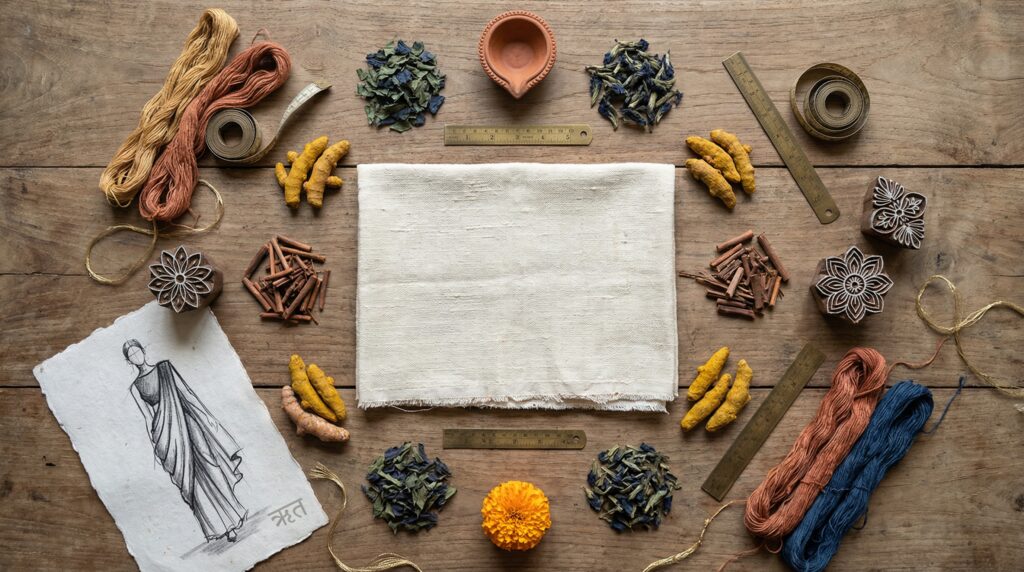
How Ancient Vedic Wisdom Shapes Modern Fashion Philosophy, Design Thinking, and Sustainable Practice
Key Takeaways (TL;DR)
- Ṛta (Cosmic Order) teaches fashion designers to create with rhythm, balance, and harmony — aligning designs with nature’s patterns rather than fighting against them.
- Dharma (Ethical Duty) establishes the moral foundation for ethical production, fair treatment of artisans, and responsible consumption in fashion.
- Pañcabhūta (Five Elements) — Earth, Water, Fire, Air, and Space — offers a practical framework for material selection, colour theory, and holistic design thinking.
- IKS-rooted fashion education prepares students for the global shift towards sustainable, slow fashion while preserving India’s rich textile heritage.
- Integrating these principles into fashion curricula aligns with the National Education Policy (NEP) 2020 and positions Indian designers as leaders in conscious fashion.
For students, educators, and professionals searching for how Indian Knowledge Systems influence fashion design, sustainability, and curriculum development, this article breaks down the three most important IKS principles shaping contemporary fashion education in India today.
Introduction: Why Indian Knowledge Systems Matter in Fashion Education
Here’s something that might surprise you: Fashion in India was never just about looking good.
For thousands of years, the way Indians dressed, the textiles they chose, and even the colours they wore were deeply connected to philosophy, spirituality, and a worldview that saw everything in the universe as interconnected. Fashion was not separate from life — it was an expression of it.
This is where Indian Knowledge Systems, or IKS, come into the picture. The interpretations presented here are drawn from widely accepted Indian philosophical and textile traditions that are increasingly being integrated into contemporary fashion education frameworks.
If you are pursuing a Diploma in Fashion Design or a BSc in Fashion & Apparel Design, understanding IKS is not just about learning history. It’s about gaining a design philosophy that can set you apart in an industry that’s increasingly hungry for meaning, sustainability, and authenticity.
With the National Education Policy (NEP) 2020 emphasising the integration of Indian traditional knowledge into contemporary education, fashion institutions across India are now recognising what our ancestors knew all along — that design rooted in timeless principles produces work that is not only beautiful but meaningful and enduring. The UGC’s recent push towards IKS integration across disciplines reflects a broader institutional acknowledgment that indigenous knowledge systems offer frameworks relevant to modern professional practice.
But what exactly are these principles? And how do they apply to someone studying fashion design today?
Let’s explore three foundational concepts — Ṛta, Dharma, and Pañcabhūta — and see how they can transform the way we think about fashion.
Understanding Indian Knowledge Systems (IKS): A Brief Overview
Before we dive into the specifics, let’s first understand what we mean by Indian Knowledge Systems.
IKS refers to the vast body of knowledge that originated in the Indian subcontinent — encompassing philosophy, science, arts, medicine, architecture, and yes, textiles and fashion. This knowledge was systematically documented in ancient texts like the Vedas, Upanishads, Arthashastra, Nāṭyaśāstra, and Kāmasūtra, among others.
What makes IKS unique is its holistic approach. Unlike modern Western frameworks that often compartmentalise knowledge into separate boxes, Indian systems viewed everything as interconnected. The way you dressed was connected to your health. Your choice of colours was connected to your emotional state. The fabric you wore was connected to the season, the occasion, and even cosmic rhythms.
This interconnected worldview is precisely what modern sustainability discourse is trying to rediscover. And for fashion students, understanding IKS isn’t just about the past — it’s about gaining a competitive edge in an industry that’s rapidly moving towards conscious, ethical design. The timing, frankly, couldn’t be better.
Ṛta: The Cosmic Order and Its Application in Fashion Design
What is Ṛta?
Ṛta (pronounced ri-ta) is one of the oldest and most profound concepts in Vedic philosophy. It refers to the cosmic order that governs the universe — the natural rhythm and harmony that keeps the seasons turning, the rivers flowing, and the stars moving in their courses.
Think of Ṛta as the underlying pattern behind all creation. It’s the reason why certain colour combinations feel naturally pleasing, why symmetry is instinctively satisfying, and why designs rooted in nature’s geometry tend to be timeless.
In simpler terms? Ṛta is the universe’s design principle.
How Ṛta Applies to Fashion Design
When you align your design thinking with Ṛta, you stop forcing things. You stop chasing arbitrary fashion trends that have no connection to anything meaningful. Instead, you start observing — nature, culture, human behaviour — and you create from that observation.
1. Harmony in Proportion and Balance
Traditional Indian garments like the saree, dhoti, and angavastram are brilliant examples of Ṛta in practice. These are not “constructed” garments in the Western sense — they are unstitched or minimally stitched fabrics that drape and flow with the body’s natural form. The proportions work because they’re based on the human body’s natural geometry, not imposed onto it.
For fashion students, this principle translates into understanding why certain proportions work and others don’t. It’s the difference between a garment that feels “right” and one that feels forced. When you study the elements and principles of fashion design, you’ll notice how Ṛta underlies many of these concepts.
2. Seasonal and Cyclical Design
Ṛta acknowledges that everything moves in cycles. The seasons change. Colours that feel appropriate in summer feel wrong in winter. Traditional Indian textiles always respected this — lightweight khadi and cotton for summers, heavier woolens and brocades for winters.
Modern sustainable fashion is essentially rediscovering this ancient wisdom. Creating seasonless, trend-agnostic clothing that respects natural cycles is Ṛta in action.
3. The Mathematics of Pattern
Look closely at traditional Indian textile patterns — whether it’s the geometric precision of Patola weaving, the intricate symmetry of Kashmiri embroidery, or the mathematical layouts of Ajrakh block printing. These patterns didn’t emerge randomly. They follow principles of sacred geometry that reflect Ṛta — the cosmic order made visible in cloth.
Learning to work with these patterns isn’t just about replicating tradition. It’s about understanding why these patterns have endured for centuries while countless “modern” designs have been forgotten.
Ṛta in the Curriculum Context
What’s often overlooked is how naturally Ṛta maps onto formal design education. In fashion education frameworks aligned with NEP 2020, such principles are increasingly positioned as foundational design thinking tools rather than cultural electives. When students learn proportion, balance, and rhythm in design theory classes, they are essentially learning Ṛta — whether or not the term is explicitly used. The difference is that an IKS-informed approach makes this connection explicit, giving students a richer conceptual vocabulary to draw from.
Dharma: Ethical Duty in Fashion Practice
What is Dharma?
Dharma is often translated as “duty” or “righteousness,” but these English words don’t fully capture its depth. Dharma is about living in accordance with your purpose, your responsibilities, and your ethical obligations — to yourself, to others, and to the world.
In the context of fashion, Dharma asks a fundamental question: What is your responsibility as a designer?
Is it merely to create beautiful things? Or is there a deeper obligation — to the artisans who make your designs possible, to the environment affected by your material choices, to the consumers who trust your craftsmanship?
How Dharma Applies to Fashion Practice
The fast fashion industry has been rightly criticised for its exploitative labour practices. The 2013 Rana Plaza disaster in Bangladesh, which killed over 1,100 garment workers, was a wake-up call for the global fashion industry.
1. Ethical Production and Fair Labour
Dharma-rooted fashion takes a different approach. Traditional Indian craft clusters — whether the weavers of Varanasi, the block printers of Rajasthan, or the Chikankari embroiderers of Lucknow — operated on principles of fair compensation, skill respect, and community welfare. These weren’t just economic relationships; they were social contracts rooted in mutual obligation.
For modern fashion professionals, Dharma means asking: Who made my clothes? Are they being paid fairly? Are their working conditions safe and dignified?
2. Responsible Material Choices
Dharma extends to our relationship with the environment. Traditional Indian textile practices used natural, biodegradable materials — cotton, silk, wool, plant-based dyes. The concept of producing something that would pollute the earth for centuries would have been considered adharmic (against Dharma).
When you choose organic cotton over conventional, natural dyes over synthetic, or handloom over power loom, you’re making a Dharmic choice. You’re fulfilling your ethical duty as a designer. This is also why sustainable fashion costs more — because it accounts for the true cost of ethical production.
3. Consumer Responsibility
Dharma isn’t just for producers — it applies to consumers too. The concept of Aparigraha (non-possessiveness), which is closely related to Dharma, encourages mindful consumption. Buying fewer, better-quality garments that last longer is a Dharmic approach to fashion consumption.
This aligns perfectly with the slow fashion movement, which encourages consumers to invest in timeless, well-made pieces rather than chasing disposable trends.
Dharma in Professional Practice
This distinction matters more than it seems. Dharma isn’t abstract philosophy — it translates directly into professional ethics codes and corporate responsibility frameworks that fashion graduates encounter in the industry. Brands increasingly publish supply chain transparency reports, conduct fair wage audits, and seek certifications like Fair Trade and SA8000. These are essentially institutionalised expressions of Dharmic principles. Students who understand the philosophical roots of ethical fashion are better equipped to navigate — and lead — these industry shifts.
Pañcabhūta: The Five Elements as a Design Framework
What is Pañcabhūta?
Pañcabhūta (pronounced panch-a-bhoota) refers to the five fundamental elements that, according to Indian philosophy, constitute all matter in the universe:
- Pṛthvī (Earth) — solidity, stability, structure
- Jala (Water) — fluidity, adaptability, flow
- Agni (Fire) — transformation, energy, radiance
- Vāyu (Air) — movement, lightness, breath
- Ākāśa (Space/Ether) — expansion, openness, potential
These aren’t just abstract philosophical concepts. They’re a practical framework for understanding materials, forms, colours, and the overall feel of a design. If you understand draping and its importance, you’ll see how Pañcabhūta naturally informs the way fabrics behave on the body.
How Pañcabhūta Applies to Fashion Design
1. Material Selection Through Elemental Thinking
Each fabric has an elemental quality. Understanding this can transform how you approach material selection:
- Earth-dominant fabrics — Heavy brocades, dense woolens, leather, denim. These provide structure, grounding, and stability. Ideal for formal wear, outerwear, and garments that need to hold their shape.
- Water-dominant fabrics — Silk, satin, chiffon, and flowing rayons. These drape fluidly, adapt to the body’s movement, and have a sensual, liquid quality. Perfect for evening wear and garments meant to move gracefully.
- Fire-dominant elements — This isn’t about fabric as much as colour and finish. Metallic threads, gold zari, bright reds and oranges, shimmering surfaces — these add energy and radiance to a design.
- Air-dominant fabrics — Sheer muslins, organza, lightweight cotton. These fabrics breathe, float, and create a sense of lightness. Essential for summer wear and layered looks.
- Space element — This is about what you don’t put in a design. Negative space, minimalist cuts, uncluttered silhouettes — these allow the garment to “breathe” and give the wearer room to exist within the design.
2. Colour Theory Through the Elements
Traditional Indian colour associations follow elemental logic. This connects to the psychology of colours in fashion that we’ve discussed before:
- Earth colours: Browns, ochres, terracotta, forest greens
- Water colours: Blues, teals, aquamarines, silvers
- Fire colours: Reds, oranges, golds, bright yellows
- Air colours: Whites, pale blues, soft greys
- Space/Ether: White, off-white, and colours that seem to “disappear”
Understanding these associations helps designers create collections that feel coherent and balanced. A collection that’s all “fire” will feel aggressive; one that’s all “water” may feel formless. The mastery lies in balancing the elements — and honestly, this is where many designers struggle without realising why.
3. Silhouette and Form
The elements also inform shape and structure:
- Earth — Structured shoulders, defined waistlines, geometric cuts
- Water — Draped silhouettes, bias cuts, flowing hemlines
- Fire — Angular designs, pointed collars, sharp tailoring
- Air — Loose fits, breathable constructions, layered looks
- Space — Minimalist designs that let the body show through
Pañcabhūta as a Design Thinking Tool
In structured fashion programmes, elemental thinking offers something that Western design frameworks sometimes lack: a unified vocabulary that connects material science, colour theory, and silhouette design under one coherent philosophy. Rather than treating these as separate subjects, Pañcabhūta allows students to see how fabric choice, colour palette, and garment structure interact as a system. This holistic approach is increasingly valued in design education that aims to produce thoughtful, versatile professionals.
IKS in Practice: Traditional Indian Textiles as Living Examples
The beauty of IKS is that it’s not abstract theory — it’s lived practice. Traditional Indian textile crafts have embodied these principles for centuries.
Khadi: Dharma in Fabric Form
Khadi — hand-spun, hand-woven cloth — is perhaps the purest expression of Dharmic fashion. Popularised by Mahatma Gandhi during the independence movement, Khadi represents self-reliance, ethical production, and resistance to exploitative industrial systems.
Today, Khadi is experiencing a documented revival. Recognised under India’s handloom and MSME ecosystem, Khadi production is supported through the Khadi and Village Industries Commission (KVIC) and various state-level handloom boards. Designer-led revival initiatives — from runway showcases to contemporary ready-to-wear — have brought Khadi into mainstream fashion consciousness. Many of India’s top fashion designers have incorporated Khadi into their collections, proving that traditional fabrics can be both meaningful and commercially viable.
For fashion students, understanding Khadi is understanding how a simple fabric can carry profound ethical and historical meaning — and how institutional frameworks support traditional textiles.
Natural Dyeing: Ṛta in Colour
Traditional Indian dyeing used plant-based colours — indigo from the Indigofera plant, red from madder root (manjistha), yellow from turmeric (haridrā), black from iron-rich mud. These dyes worked in harmony with natural fibres, producing colours that aged gracefully rather than fading into ugly tones.
This is Ṛta in practice — working with nature’s chemistry rather than against it. Modern fashion is slowly returning to these methods as consumers demand non-toxic, environmentally safe options.
Regional Weaving Traditions: Pañcabhūta Made Visible
Each regional textile tradition in India emphasises different elements. Many of these are protected under India’s Geographical Indication (GI) registry, which recognises their cultural and geographical specificity:
- Banarasi brocades (GI-tagged) — Fire-dominant with their gold zari and rich colours
- Bengali Jamdani (GI-tagged) — Air-dominant with their gossamer-thin weave
- Gujarati Bandhani — Water-dominant with their fluid, tie-dyed patterns
- Kutchi embroidery (GI-tagged) — Earth-dominant with their mirror work and dense stitching
Understanding these traditions through the lens of Pañcabhūta helps designers appreciate why certain techniques evolved in certain regions — and how to apply similar principles in contemporary design. The GI protection also offers a framework for intellectual property awareness that fashion professionals increasingly need.
IKS and Sustainable Fashion: Ancient Solutions to Modern Problems
Here’s something worth pondering: many of the “innovations” in sustainable fashion are simply rediscoveries of traditional Indian practices.
- Zero-waste pattern cutting? Traditional garments like sarees and dhotis produce virtually no fabric waste.
- Natural, biodegradable materials? India has used cotton, silk, wool, and plant fibres for millennia.
- Slow fashion? Traditional garments were made to last for decades, often passed down through generations.
- Local production? Regional craft clusters kept production close to home, minimising transportation emissions.
- Artisan empowerment? Traditional craft economies provided dignified livelihoods for millions.
The global fashion industry is spending billions trying to become more sustainable. India already has a blueprint — we just need to recognise its value and adapt it for contemporary contexts. That’s not nationalism talking; it’s just practical sense.
For students pursuing fashion design courses, this represents both a challenge and an opportunity. The challenge is learning to work with traditional methods in a modern market. The opportunity is positioning yourself as a designer who can bridge ancient wisdom and contemporary demand.
Integrating IKS into Fashion Education
At institutions like IIFT Bangalore, the integration of IKS into fashion education isn’t just about adding a few heritage-focused courses. It’s about fundamentally rethinking how we teach design.
What IKS-Integrated Fashion Education Looks Like
1. Philosophy Alongside Technique — Students learn not just how to drape fabric, but why certain draping methods evolved and what they signify.
2. Material Science Meets Traditional Knowledge — Understanding why natural fibres behave as they do, why certain dyes bond with certain fabrics, and how traditional artisans developed these insights through generations of observation.
3. Ethics as Core Curriculum — Dharmic thinking ensures that ethical considerations aren’t an afterthought but a foundational element of design education.
4. Sustainability by Default — When you design with IKS principles, sustainability isn’t an add-on — it’s built into your approach from the start.
5. Cultural Confidence — Perhaps most importantly, IKS education gives Indian designers confidence in their own heritage. Rather than constantly looking West for validation, they can draw from a deep well of indigenous knowledge.
This approach aligns with what the scope of fashion designing in India is becoming — a field where cultural rootedness is increasingly valued alongside technical skill.
How IKS-Based Design Prepares Fashion Students for the Future Industry
The global fashion industry is undergoing a structural transformation. Sustainability is no longer a niche concern — it’s becoming a regulatory and market imperative.
The European Union’s proposed textile regulations, increasing consumer demand for transparency, and the rise of circular fashion models all point in one direction: the industry needs designers who think systemically, ethically, and with long-term horizons.
This is precisely where IKS-trained designers have an advantage.
1. Systems Thinking Over Trend-Chasing
Designers trained in IKS principles approach fashion as an interconnected system — material, craft, consumer, environment — rather than isolated trend cycles. This mindset aligns with the industry’s shift towards circular design, where end-of-life considerations are built into the design process from the start.
2. Cultural Authenticity as Market Differentiator
Global luxury brands are increasingly seeking designers who can offer genuine cultural narratives, not surface-level “ethnic inspiration.” IKS-trained designers can provide this depth authentically, positioning themselves for roles in heritage brands, artisan collaborations, and culturally-rooted luxury segments.
3. Sustainability Literacy
What the industry calls “sustainability” — ethical sourcing, natural materials, artisan welfare, biodegradability — is largely what IKS has practiced for centuries. Students with this foundation don’t need to learn sustainability as an add-on; they understand it as default practice.
4. Global Relevance, Indian Roots
The international fashion market is paying attention to India. From handloom exports to designer collaborations with European luxury houses, Indian textile traditions are gaining global recognition. Designers who understand both the philosophical depth and practical techniques of these traditions are well-positioned for international opportunities.
Why IKS Matters in Contemporary Fashion Education in India
Fashion education in India stands at an interesting juncture. On one hand, the industry demands technical proficiency in CAD, pattern-making, and global trend analysis. On the other, there’s growing recognition that Indian designers have access to a heritage of textile knowledge that most of the world has lost.
IKS integration isn’t about choosing tradition over modernity. It’s about equipping students with both — contemporary industry skills and a philosophical framework that gives their work depth, meaning, and differentiation. These perspectives align with the direction outlined by national education and skill-development frameworks, where IKS is positioned as a foundational knowledge system rather than an elective cultural add-on.
Institutions that successfully integrate IKS into their curricula are essentially producing graduates who can:
- Navigate global fashion systems while drawing from indigenous knowledge
- Create work that resonates with increasingly values-driven consumers
- Contribute to sustainability discourse with practical, time-tested alternatives
- Position Indian fashion as a source of intellectual leadership, not just manufacturing capacity
This is the opportunity — and the responsibility — that contemporary fashion education in India carries.
The Future of IKS in Fashion
The global fashion industry is at a crossroads. The fast fashion model is increasingly recognised as unsustainable — environmentally, socially, and even economically. Consumers, especially younger ones, are demanding transparency, ethics, and meaning in what they wear.
Indian designers trained in IKS principles are uniquely positioned to lead this transformation. They can offer something the global market desperately needs: fashion that is rooted, meaningful, sustainable, and beautiful — not despite these qualities, but because of them.
This isn’t about nostalgia or retreating into the past. It’s about bringing forward the wisdom of the past to solve the problems of the present and future.
If you’re considering a career in fashion design, understanding IKS won’t just make you a better designer. It will make you a more thoughtful, responsible, and culturally grounded professional. And in an industry hungry for authenticity and meaning, that’s perhaps the most valuable credential of all.
Interested in learning more about how to become a fashion designer with a foundation in both contemporary skills and traditional wisdom? For students seeking fashion education that balances industry-ready technical training with India’s intellectual and cultural heritage, exploring structured programmes becomes the natural next step.
Frequently Asked Questions (FAQs)
1. How can learning IKS help my fashion career?
Understanding IKS positions you as a designer who can create meaningful, sustainable fashion rooted in cultural authenticity — qualities increasingly valued by global consumers and brands. It differentiates you in a market saturated with designers trained only in Western approaches.
2. How does IKS relate to sustainable fashion?
IKS and sustainable fashion share significant overlap. Traditional Indian practices — natural materials, zero-waste construction, artisan-based production, durability focus — align with modern sustainability goals. IKS provides the philosophical framework for what the sustainability movement is trying to achieve.
3. What is Indian Knowledge System (IKS) in fashion?
IKS in fashion applies traditional Indian philosophical principles — Ṛta (cosmic order), Dharma (ethical duty), and Pañcabhūta (five elements) — to design, textile selection, production, and consumption. It integrates India’s textile heritage with contemporary design thinking.
4. Why is IKS being introduced in fashion education now?
NEP 2020 emphasises integrating Indian knowledge traditions into contemporary education. The global fashion industry’s sustainability crisis has also created renewed interest in traditional practices that were inherently sustainable.
5. How is IKS different from just studying traditional Indian textiles?
Traditional textile study focuses on techniques, history, and regional crafts. IKS goes deeper into the philosophical why behind these practices and applies those principles to modern design challenges, including sustainability and ethical production.
6. Do I need to know Sanskrit or study ancient texts to understand IKS in fashion?
No. Fashion education integrates IKS principles in accessible ways. You’ll learn the concepts through practical application — material selection, design philosophy, ethical production — rather than linguistic study.
7. Which fashion design courses at IIFT Bangalore incorporate IKS principles?
IIFT Bangalore’s programmes, including the BSc in Fashion & Apparel Design, Diploma in Fashion Design & Boutique Management, PG Diploma in Fashion Design, and Masters in Fashion Management, integrate IKS principles through curriculum elements focused on Indian textiles, sustainable practices, and design philosophy.
8. Is IKS only relevant for designing Indian ethnic wear?
Not at all. IKS principles — balance, harmony, ethical production, elemental thinking — apply to any design context, from Western tailoring to sportswear to haute couture. The principles are universal; their application is flexible.
9. Can IKS principles be applied to fashion styling and communication?
Absolutely. The Diploma in Fashion Styling & Communication at IIFT Bangalore teaches students to understand the cultural and philosophical context of garments, which is essential for styling that tells meaningful stories rather than simply following trends.
10. Where can I learn more about fashion design rooted in Indian culture?
You can explore the IIFT Bangalore blog for articles on topics ranging from fashion illustration to textile innovations and sustainable practices. For formal education, check out the fashion design courses offered at IIFT Bangalore.
For students and professionals seeking fashion education that integrates contemporary industry skills with India’s rich intellectual and cultural heritage, IIFT Bangalore’s fashion design programmes offer a structured pathway. Explore admissions for the upcoming batch.