

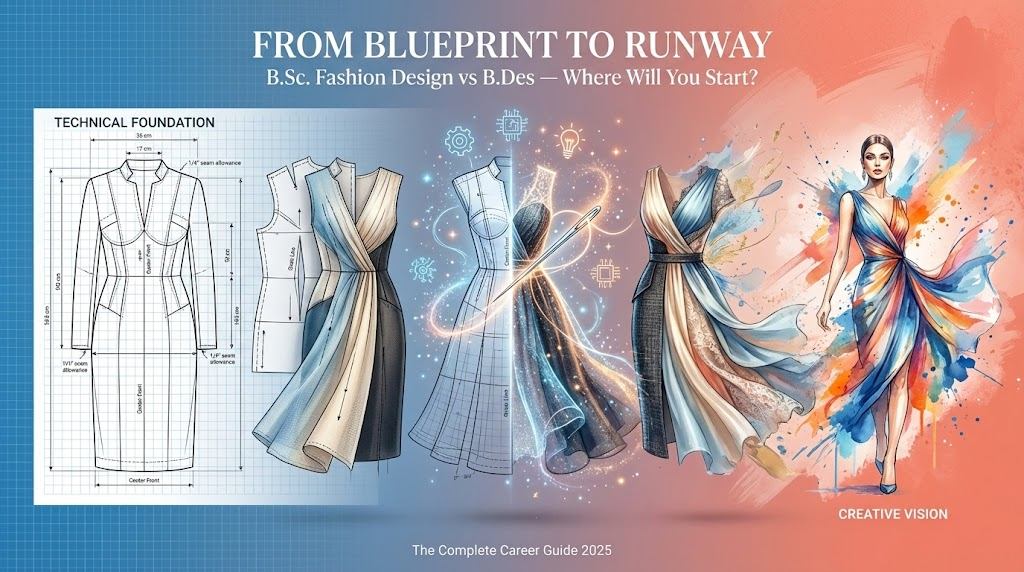
Introduction: Understanding the Fashion Education Landscape in India
Choosing a fashion degree after 12th can feel overwhelming. With so many options floating around such as B.Sc. Fashion Design, B.Des, diploma courses, even international programs; it’s easy to get lost in the noise. And here’s the thing: most online resources just throw buzzwords at you without actually explaining what makes these degrees different in practical terms.
If you’ve landed here searching for “BSc Fashion Design vs BDes” or “which is better BDes or BSc fashion,” you’re probably looking for a straight answer. Let’s get into it.
The Indian fashion industry isn’t just about Lakme Fashion Week and celebrity designers. It’s a massive ecosystem worth over $100 billion, encompassing textile manufacturing, garment exports, retail fashion, sustainable fashion startups, fashion technology, and yes, luxury design too. The degree you pick should align with where you actually want to work, not just what sounds prestigious.
This guide breaks down B.Sc. in Fashion & Apparel Design and B.Des (Bachelor of Design – Fashion) across every dimension that actually matters: curriculum structure, career outcomes, industry relevance, and long-term versatility. By the end, you’ll have a clear picture of which path suits your aspirations.
Quick Overview: B.Sc. Fashion & Apparel Design vs B.Des
Before diving deep, here’s the fundamental distinction you need to understand:
B.Sc. in Fashion & Apparel Design is a science-based undergraduate degree that combines technical knowledge of textiles, garment construction, and production processes with design fundamentals. It prepares students for industry-oriented roles across the fashion supply chain.
B.Des (Bachelor of Design – Fashion) is a design-focused degree that emphasizes conceptual thinking, aesthetics, visual communication, and creative exploration. It’s structured around design philosophy and tends to focus more on high-fashion and luxury design contexts.
Neither is universally “better”, they serve different purposes. But for most students entering the Indian fashion job market, one of these paths offers significantly broader opportunities. Let’s explore why.
Detailed Comparison: Curriculum, Skills, and Focus Areas
Course Orientation: Technical + Scientific vs Conceptual
The philosophical difference between these programs shows up immediately in how they’re structured.
B.Sc. Fashion & Apparel Design treats fashion as an applied science. You’ll study textile science, understand fiber properties, learn about fabric behavior under different conditions, and gain hands-on experience with garment construction techniques. The curriculum assumes you need to understand how things work and not just how they look.
Typical subjects include textile chemistry, yarn and fabric manufacturing, quality control, pattern making, draping, CAD/CAM applications, apparel production management, and costing. There’s also design work and of course illustration, color theory, fashion forecasting but it’s grounded in technical understanding.
B.Des Fashion approaches fashion primarily through a design lens. The focus is on developing a unique creative voice, understanding design history and theory, exploring visual culture, and building conceptual frameworks for collections. Technical skills are included but aren’t the primary emphasis.
Students spend significant time on portfolio development, design ideation, trend research, and understanding fashion as cultural expression. The goal is often to produce designers who can create original, thought-provoking work.
Curriculum Breakdown: What You’ll Actually Learn
Here’s a side-by-side look at typical curriculum components:
| Aspect | B.Sc. Fashion & Apparel Design | B.Des Fashion |
|---|---|---|
| Textile Science | Extensive (fiber properties, fabric testing, textile chemistry) | Basic to moderate |
| Garment Construction | In-depth (industrial techniques, mass production methods) | Focus on bespoke/couture techniques |
| CAD/CAM & Technology | Core component (industry-standard software) | Usually elective or limited |
| Production Management | Yes (supply chain, costing, quality control) | Minimal or absent |
| Design Philosophy | Foundational coverage | Extensive (theory, history, conceptual development) |
| Portfolio Development | Industry-focused portfolio | Creative/artistic portfolio emphasis |
| Industry Internships | Typically, mandatory across multiple functions | Usually design studio focused |
The curriculum difference isn’t subtle. B.Sc. programs spend substantial time on textile testing labs, understanding how different fibers behave, learning industrial sewing machines and production line workflows. B.Des programs invest that time instead in design studios, critique sessions, and conceptual exploration.
Industry Readiness and Employability: Where the Rubber Meets the Road
Let’s be honest; most students pursue fashion degrees because they want jobs in the fashion industry. So how do these programs stack up in terms of actual employability?
The Indian Fashion Industry Reality Check
India’s fashion sector is enormous, but it’s not structured the way Bollywood movies suggest. The industry breaks down roughly like this:
Apparel Manufacturing & Exports: The largest employer by far. Companies producing garments for international brands like H&M, Zara, Gap, and dozens more. Think Tirupur, Bangalore, NCR, Ludhiana.
Domestic Retail & Private Labels: Brands like Westside, Shoppers Stop private labels, Myntra’s in-house brands, and countless regional players.
Textile Industry: Fabric mills, processing units, textile trading which is the backbone of everything else.
Designer Labels & Luxury: Sabyasachi, Manish Malhotra, Anita Dongre, etc. Glamorous, but employs a tiny fraction of fashion graduates.
Fashion Tech & E-commerce: Product cataloging, styling, fashion technology, trend analytics which are growing at a rapid pace.
When you actually talk to people working inside the industry, a very different picture emerges from what college brochures usually show. During counselling conversations and informal chats with students already interning in export houses or retail brands, one thing comes up repeatedly: most fashion jobs are operational, not glamorous. Many students enter fashion education imagining sketchbooks and runway shows, only to realize by their second or third year that the real demand lies in managing fabrics, timelines, suppliers, fits, and quality. This realization can feel disappointing at first, but for those who adapt early, it becomes a career advantage rather than a compromise.
B.Sc. Fashion & Apparel Design: Built for Industry Absorption
The B.Sc. curriculum essentially mirrors what the industry needs. When a garment export company hires fresh graduates, they’re looking for people who understand:
- How to read and create tech packs
- Pattern making and grading for different sizes
- Fabric selection based on garment requirements
- Quality control checkpoints and testing
- CAD software for pattern development
- Basic costing and production planning
What stands out in interviews isn’t just knowledge, it’s familiarity. Recruiters can tell almost immediately whether a student understands how a factory floor works or whether their learning has stayed inside classrooms. Students from B.Sc. programs often talk comfortably about sampling delays, fabric shrinkage issues, buyer comments, or cost negotiations. It’s not that they’re more talented creatively, but they’ve been trained to think in constraints. And in an industry where deadlines and margins matter, that mindset tends to outperform raw creativity alone.
B.Des Fashion: Designed for a Different Path
B.Des programs produce graduates skilled in design conceptualization and creative thinking. These are valuable skills, but they fit a narrower set of roles – mainly design assistant positions at designer labels, styling work, or roles that specifically require strong creative portfolios.
The challenge? These positions are limited in number and highly competitive. A mid-sized designer label might hire one or two design assistants per year. Meanwhile, garment manufacturers in Bangalore alone post hundreds of openings for merchandisers, production executives, and quality controllers.
Career Paths and Job Roles: A Realistic Assessment
Careers After B.Sc. in Fashion & Apparel Design
The career versatility of B.Sc. graduates is genuinely impressive. Here are realistic job roles:
Fashion/Apparel Merchandiser: Coordinates between design, production, and sales. One of the most in-demand roles in the industry.
Production Manager/Executive: Oversees manufacturing processes, timelines, and quality standards.
Quality Assurance Specialist: Ensures products meet quality specifications and buyer requirements.
Technical Designer: Creates technical specifications, fit approvals, and construction details.
CAD Designer/Pattern Technologist: Develops digital patterns and manages grading processes.
Fashion Buyer: Selects and purchases products for retail chains.
Sourcing Specialist: Identifies vendors, negotiates prices, manages supplier relationships.
Fashion Designer: Yes, B.Sc. graduates can absolutely become designers with technical skills as a foundation.
Textile Designer: Creates fabric prints, textures, and surface designs.
E-commerce Fashion Cataloger: Product photography styling, attribute management, category expertise.
Fashion Entrepreneur: Launch your own brand with solid understanding of production and costing.
Careers After B.Des Fashion
B.Des graduates typically target these roles:
Fashion Designer: Design assistant to eventually lead designer at labels.
Costume Designer: Film, television, and theater costume design.
Fashion Stylist: Editorial, celebrity, or commercial styling.
Creative Director: Long-term goal for exceptionally talented individuals.
Fashion Illustrator: For publications, brands, or freelance work.
Visual Merchandiser: Store displays and retail experience design.
This is where many students wish someone had been more honest with them earlier. There’s no universally superior degree, but there is a better fit depending on how you think, how you learn, and how much uncertainty you’re willing to tolerate early in your career. Some students thrive in open-ended creative environments, while others feel lost without structure and real-world application. The problem is that most people only discover which category they fall into after enrolling. Thinking through this distinction upfront can save years of frustration.
Who Should Choose Which Degree? A Decision Framework
Rather than declaring one “better” than the other, let’s match profiles to programs:
Choose B.Sc. in Fashion & Apparel Design If You:
- Want job security with multiple career options
- Are interested in how garments are actually made, not just designed
- Want to work in export houses, retail brands, or manufacturing
- See yourself potentially in merchandising, buying, or production roles
- Plan to start your own brand someday and need to understand costing/production
- Prefer a practical, hands-on learning approach
- Want skills that translate across different fashion industry segments
- Are from a science background in 12th and want to leverage that foundation
- Interested in sustainable fashion and ethical manufacturing
Choose B.Des Fashion If You:
- Have a strong, specific vision to become a fashion designer at established labels
- Are deeply interested in design theory, fashion history, and conceptual fashion
- Prioritize creative expression over commercial viability
- Have family connections in the luxury fashion segment
- Plan to pursue design at institutions that specifically require B.Des
- Are comfortable with a narrower but deeper creative focus
- Have financial runway to pursue competitive creative roles
Cost-Effectiveness and Return on Investment
Without getting into specific fee structures (which vary wildly by institution), there are some general patterns worth noting.
B.Des programs at premier design institutes tend to command premium pricing, reflecting their brand value and faculty reputation. B.Sc. programs at quality institutes often come at more accessible price points while delivering strong industry outcomes.
The ROI calculation, however, isn’t just about fees, it’s about time-to-employment and salary progression. B.Sc. graduates often secure placements faster due to broader employability, and the diverse skill set allows for salary growth through role transitions (say, from production to merchandising to buying, with corresponding salary jumps).
For families where education investment is a careful decision, B.Sc. in Fashion & Apparel Design often presents a more favorable risk-reward profile.
The Bottom Line: Making Your Decision
Both B.Sc. in Fashion & Apparel Design and B.Des are legitimate paths into the fashion industry. But they’re designed for different destinations.
If you’re certain you want to pursue haute couture design and have the financial flexibility to navigate a competitive creative job market, B.Des offers focused preparation for that specific path.
For everyone else which is basically most of the students, B.Sc. in Fashion & Apparel Design offers a smarter, more versatile investment. It opens doors across the entire fashion ecosystem, from design studios to manufacturing floors, from retail buying offices to e-commerce platforms, from fabric sourcing to quality labs.
The fashion industry rewards people who understand how things work, not just how things look. Technical knowledge combined with design sensibility creates professionals who can operate anywhere in the value chain and those are the people who build sustainable, evolving careers in fashion.
Your degree choice should reflect not the career you romanticize but the career you’ll actually build. For most students entering Indian fashion in 2024 and beyond, that career is best served by the solid, industry-aligned foundation of B.Sc. in Fashion & Apparel Design.
Whatever you choose, ensure the institute you select offers strong industry connections, practical curriculum delivery, and genuine placement support. The degree matters, but how well it’s taught matters even more.
Frequently Asked Questions
Can I become a fashion designer with a B.Sc. degree?
Absolutely. Many successful designers have technical education backgrounds. In fact, understanding garment construction and textiles deeply can make you a more effective designer. You just approach design from a production-aware perspective, which many brands actually prefer.
Is B.Sc. Fashion recognized as equivalent to B.Des?
Both are recognized undergraduate degrees. For most industry hiring, companies care more about skills and portfolio than the specific degree title. B.Sc. is often preferred by manufacturing, retail, and export companies precisely because of its technical curriculum.
Which degree is better for working abroad?
International fashion companies especially in sourcing, merchandising, and production actively recruit graduates with technical apparel knowledge. B.Sc. graduates find opportunities in global sourcing offices, buying houses, and international retail operations. B.Des might be preferred for designer roles at European luxury houses, but those positions are extremely limited.
Can I pursue a Master’s degree after B.Sc. Fashion?
Yes. Options include Masters in Fashion Management, M.Sc. in Fashion Technology, MBA in Fashion Management, M.Des at various institutes, and even international Master’s programs. The B.Sc. foundation doesn’t limit higher education options.
What if I change my mind about my career direction?
This is actually where B.Sc. shines. The diverse skill set means you can pivot between roles. Started in production but realize you love trend research? Your textile knowledge transfers beautifully. Want to move into sustainable fashion consulting? Your technical understanding of materials becomes invaluable.




Discussion