

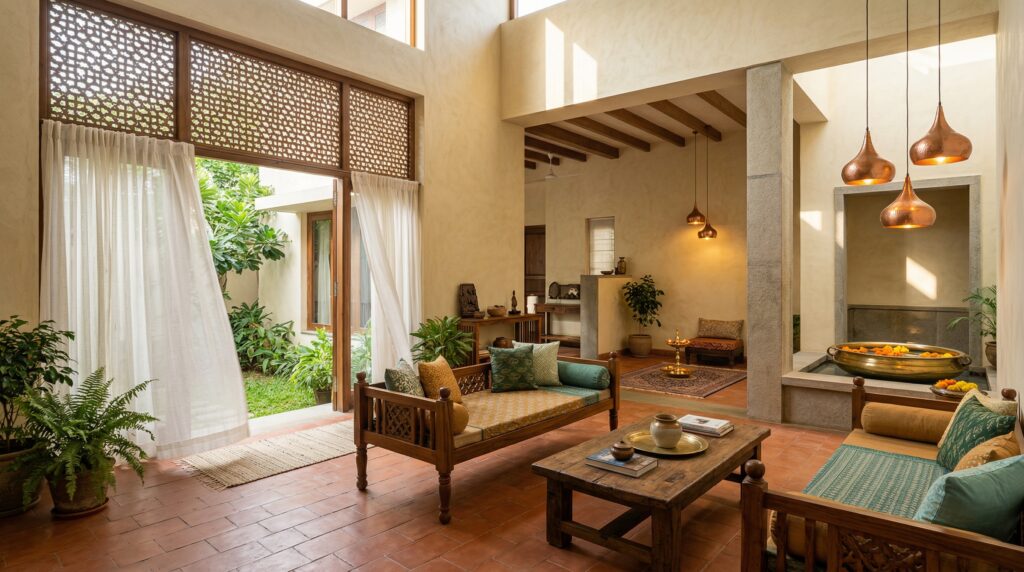
There is something in the way a traditional Indian interior manages to feel simultaneously structured and breathable — an effect that is rarely accidental. The carved jāli screen filtering afternoon light in a Rajasthani haveli, the open nadumuttam of a Kerala nalukettu drawing in rain and sky, the precise emptiness at the centre of a Dravidian temple complex — these are not aesthetic choices made in isolation. They are the spatial expression of a philosophical system so systematically developed that it anticipated, by centuries, what contemporary environmental psychology now calls biophilic design.
At the heart of this system lies the concept of Pañcabhūta — the five elemental principles that, according to Vedic and Upanishadic cosmology, constitute all matter and experience in the universe. For students, practitioners, and scholars of design, understanding Pañcabhūta is not an exercise in antiquarianism. It is an encounter with one of the most coherent frameworks for human spatial experience ever codified in the built environment.
Understanding the principles and fundamentals of interior design in their contemporary context becomes considerably more grounded when situated within this deeper philosophical tradition — one that never separated aesthetics from environment, or spatial beauty from human well-being.
The Cosmological Foundation
The Upanishadic Sequence of Creation
The Pañcabhūta doctrine has deep roots across the Vedic corpus. Its earliest systematic articulation appears in the Taittirīya Upaniṣad, which describes the universe as evolving sequentially — from space (ākāśa) through air, fire, water, and finally earth — a progression representing increasing degrees of material density and perceptual concreteness. The Ṛgveda frames the cosmos in terms of elemental forces: Agni as divine fire and creative principle, Vāyu as cosmic breath and movement, Āp as primordial water and flow. These were not poetic metaphors in isolation; they were functional categories for understanding how the world coheres and how human beings exist within it.
What differentiates the Indian elemental framework from parallel cosmological traditions is its explicit, documented connection to sensory experience. The Sāṃkhya school of philosophy — among the oldest structured philosophical systems in the world — developed a taxonomy of matter in which each element carries a specific sensory correlate: Ākāśa with sound (śabda), Vāyu with touch (sparśa), Agni with form and sight (rūpa), Jala with taste (rasa), and Pṛthvī with smell (gandha). The full spectrum of human sensory awareness is thus mapped onto the elemental world.
A Multi-Sensory Theory of Space
This multi-sensory conception is one of the most underappreciated aspects of IKS design thinking. Where contemporary interior design still largely privileges visual experience, the elemental framework demands equal attention to acoustic quality, thermal comfort, olfactory atmosphere, and haptic sensation. A room, in this framework, is not merely something to look at — it is something to inhabit fully, through all the senses simultaneously. This is, arguably, a more complete theory of interior space than much of what contemporary Western practice offers, and one that researchers in environmental psychology are only now beginning to systematically validate.
This elemental thinking extends well beyond architecture. The principles of design across disciplines — whether in fashion, textile arts, or spatial practice — all draw from the same underlying cosmological intelligence that IKS preserves and transmits.
Vāstu Śāstra: The Textual Codification of Elemental Space
Major Treatises and Their Intellectual Scope
The philosophical principles of Pañcabhūta found their most systematic architectural expression in Vāstu Śāstra — a body of knowledge codified in treatises such as the Mānasāra, the Mayamata, the Kāśyapa Śilpa, and the Samarāṅgaṇa Sūtradhāra. These texts span approximately from the 1st millennium BCE through the medieval period and represent regional intellectual traditions — North Indian (Nāgara), South Indian (Drāviḍa), and mixed (Vesara) — within a shared philosophical framework. They constitute the most extensive pre-modern literature on the design of human space produced within any single civilisational tradition.
Importantly, these are not prescriptive building codes in the modern sense. They are comprehensive philosophical treatises on the relationship between cosmic order and spatial form — the argument that a well-built space participates in, rather than merely occupies, the natural world. The Śilpa Śāstra texts, particularly those in the South Indian Āgamic tradition, extend this concern to the proportional systems governing carved form, material selection, and the precise sensory atmosphere of interior spaces.
The Vāstu Puruṣa Maṇḍala: Elemental Geography of a Plan
The Vāstu Puruṣa Maṇḍala — the geometric diagram underlying site and building planning in Vāstu Śāstra — is typically an 8×8 or 9×9 square grid assigning specific deities and elemental forces to each zone. The grid functions as a spatial algorithm for distributing function, mass, light, water, and ventilation across a plan in ways that align with the climatic and environmental reality of the Indian subcontinent:
- Northeast (Īśāna koṇa) — Governed by water; prescribed for entrances, wells, and water storage
- Southeast (Agni koṇa) — Governed by fire; appropriate for kitchens and zones of active energy
- Southwest (Naiṛtya) — Governed by earth and mass; suitable for heavy walls, master spaces, and structural anchors
- Northwest (Vāyavya koṇa) — Governed by air and movement; suited to guest rooms and transitional spaces
- Centre (Brahmasthan) — Governed by Ākāśa; prescribed to remain open, unbuilt, and energetically clear
This directional elemental zoning aligns, in measurable practical terms, with passive solar design principles and cross-ventilation mechanics that modern architectural engineering has independently validated — a convergence deserving far more attention in mainstream design discourse.
Pṛthvī — Earth, Mass, and Material Intelligence
The Southwest Principle and Climatic Logic
Of the five elements, Pṛthvī (earth) is the most spatially tangible and the most immediately legible in heritage buildings. Its governance of the southwest quadrant has a clear climatic rationale: placing the heaviest built mass toward the south and west shields the structure from harsh afternoon sun while leaving the north and east relatively open to receive soft morning light and cooling prevailing breezes. This is not a mystical instruction but an observational one, calibrated to the solar and wind patterns of the subcontinent as experienced and recorded across centuries.
Regional Material Traditions as Elemental Expression
The earth element’s architectural vocabulary across India is striking in its regional specificity, demonstrating how the Pṛthvī principle adapts to local conditions rather than imposing a uniform aesthetic. The laterite construction traditions of Kerala and coastal Karnataka employ a stone formed from the very tropical earth of those regions — quarried soft, hardening with exposure to air, drawing the built structure into an elemental dialogue with its landscape. The red sandstone havelis of Rajasthan express Pṛthvī through warm-toned mass, capturing and slowly releasing solar heat in a desert climate where thermal lag is a survival mechanism. The granite temple complexes of Tamil Nadu employ one of the densest and most structurally stable building materials available in nature — a material whose weight and permanence embody the earth element’s qualities directly.
This is not coincidence but the expression of a design tradition that understood material selection as an elemental decision, not merely an economic or aesthetic one. The choice of what a space is made of carries philosophical weight in the IKS framework — a principle that resonates directly with natural textiles and materials in Indian home furnishing traditions, where material origin and elemental character have always been considered alongside function and appearance.
Applying Pṛthvī in Contemporary Interior Practice
For contemporary designers drawing on IKS principles, the earth element suggests:
- Weighted, low-lying furniture arrangements anchored in the southwest of a plan
- Natural stone, terracotta, or handmade tile as primary floor finish vocabulary
- Earthy colour palettes — warm ochres, terracotta reds, raw umbers, and deep forest greens
- Heavy textiles such as hand-loomed cotton, block-printed wool, and raw silk for upholstery in grounded zones
- Structurally significant furniture — carved wood, stone-topped surfaces, cast iron — positioned in the room’s southwestern anchor
The goal is not to replicate vernacular forms literally but to understand the sensory and psychological logic they carry: stability, permanence, and the quality that environmental psychologists call groundedness — a measurable psychological state associated with reduced anxiety and greater spatial confidence.
Jala — Water, Fluidity, and the Northeast Axis
The Physics and Philosophy of Water Placement
The water element is associated with the north and northeast in Vāstu Śāstra — a placement that carries both symbolic and practical rationale. The northeast in the Indian subcontinent receives the mildest sun angle and lowest heat gain, making it climatically well-suited for water storage, which benefits from cooler, more stable ambient temperatures. The elemental logic here operates simultaneously on symbolic registers (the northeast as the direction of clarity, purity, and auspicious beginning) and environmental ones — demonstrating, again, the IKS tradition’s integration of cosmological and observational knowledge.
Stepwells and Civic Water Architecture
The documented stepwells of Gujarat and Rajasthan represent the Jala element realised at its most architecturally ambitious. Rāṇī kī Vāv in Patan — a UNESCO World Heritage Site dating to the 11th century CE, rediscovered in fully preserved condition through archaeological excavation — is a choreographed spatial descent toward water through seven tiers of carved galleries, figure niches, and colonnaded landings. The spatial experience changes measurably as one descends: light levels shift, temperatures drop, acoustic qualities transform, and humidity rises. The building performs thermal regulation, social function, and elemental reverence in a single integrated architectural gesture.
Chand Bāorī in Abhaneri, equally well-documented, achieves a similar effect through a dramatically geometric plan — 3,500 narrow steps arranged in a perfect inverted pyramid descending 20 metres to the water surface. Both structures have been studied by architectural historians and building physicists as evidence that passive climate design and monumental spatial experience are not competing ambitions in the IKS tradition but one and the same.
Jala as Interior Design Sensibility
In interior design, the Jala element operates across multiple scales simultaneously. At the functional level, it recommends water features — hauz basins, wall fountains, and decorative water vessels — positioned in northeast zones. At the material and atmospheric level, Jala manifests through:
- Reflective surfaces that invoke water’s mirroring quality: polished stone, brass vessels, clear glass, and mirror insets
- Curved and flowing furniture forms that resist the rigidity associated with the earth element
- Blue-green colour palettes — from deep teal to soft aquamarine — whose restorative and calming effects are well-documented in the psychology of colour in designed spaces
- Layered transparent and semi-transparent material planes that suggest depth and visual fluidity
Jala also encodes spatial adaptability: the principle that spaces should breathe and respond to their inhabitants rather than imposing a fixed aesthetic. Furniture arrangements that allow reconfiguration, modular storage, and multipurpose zones all carry the philosophical signature of this element.
Agni — Fire, Transformation, and Spatial Vitality
The Southeast and the Logic of Activation
Agni is associated with the southeast and governs transformation, energy generation, concentrated light, and metabolic activity. In India’s predominantly warm climate, the southeast receives morning sunlight followed by good cross-ventilation — conditions suited to heat-generating activities. More philosophically, Agni governs any zone of creative intensity: the workshop, the studio, the kitchen where raw matter is transformed into nourishment. The prescription for kitchens in the southeast is not arbitrary; it encodes an understanding that spaces of active transformation benefit from the southeast’s specific climatic character and, symbolically, from their alignment with Agni’s directional energy.
Agni in Temple Architecture: The Bṛhadīśvara
Agni’s most enduring expression in built form appears in the ascending logic of South Indian temple architecture. The Bṛhadīśvara Temple in Thanjavur (c. 1010 CE), commissioned by the Chola emperor Rājarāja I and inscribed as a UNESCO World Heritage Site, is a monumental realisation of fire’s transforming energy in stone. Its 66-metre vimāna — still among the tallest completed granite towers in the world — functions architecturally as ascending flame: successive bands of carved sculpture condense and intensify upward, the octagonal śikhara at the apex drawing the eye in a movement that physically mimics the directional nature of fire. The sanctum’s interior, calibrated precisely per Āgamic texts, was designed to generate concentrated, intense spatial presence — austere and contained in deliberate contrast to the elaborately animated exterior. The tension between these two registers is Agni’s spatial grammar: concentrated energy within, expansive expression outward.
Translating Agni into Interior Practice
For the interior designer, the fire element suggests:
- Layered warm-spectrum lighting — ambient, accent, and task — with directionality that mimics flame
- Strategic use of copper, bronze, and brass in hardware, vessel, and decorative accents
- Deep reds, golds, and burnt oranges in the accent palette for high-activity zones
- Handcrafted, heat-formed objects — ceramics, cast metal, blown glass — that carry the mark of fire in their material history
- Positioning home offices, creative studios, and kitchens in southeastern zones of the plan
Vāyu — The Invisible Architect
Cross-Ventilation as Spatial Philosophy
Of all five elements, Vāyu (air) is the one most immediately verified by modern building science. Its significance in Vāstu Śāstra — governed by the northwest — is essentially a sophisticated theory of natural ventilation and pneumatic space, codified centuries before fluid dynamics emerged as a formal discipline. Placing transitional and secondary spaces in the northwest positions the least permanently occupied zones where wind-driven pressure differentials are most easily managed, ensuring air flows through inhabited areas rather than stagnating within them.
The Courtyard Tradition: Nalukettu, Haveli, and the Chowk
The courtyard house traditions of India realise the Vāyu element with remarkable consistency across radically different regions and climates. In Kerala’s nalukettu, the nadumuttam (central open courtyard) is simultaneously a sacred ceremonial space, a domestic working zone, and a passive cooling engine. Its wooden-pillared galleries create shaded circulation corridors while the central void generates a stack effect: hot air rises and escapes upward while cooler air is drawn from surrounding rooms into the inhabited space. In the multi-storeyed havelis of Rajasthan, the internal chowk serves an identical thermodynamic function in a desert climate — capturing cooler night air, releasing it slowly through the day, and reducing interior temperatures significantly without mechanical intervention.
Building physics research examining these courtyard typologies consistently documents temperature reductions of 3–7°C in traditionally designed courtyard structures compared to sealed built forms of equivalent mass — a figure that renders the Vāyu principle not a philosophical aspiration but a measurable thermal engineering achievement.
Vāyu in Contemporary Interior Practice
For the practitioner, the air element translates into several actionable principles:
- Cross-ventilation pathways as a primary planning consideration, ensuring openings on at least two opposing sides of each habitable zone
- Light, breathable soft furnishings — fine cotton, linen, open-weave muslin, cotton voile — that respond visibly to air movement
- Indoor plants positioned to improve air quality, drawing from the tradition of placing medicinal plants like tulsi at the heart of the domestic interior
- Avoidance of heavy, space-consuming furniture configurations in northwest zones that might impede natural airflow
- The use of khadi and natural fibre traditions in textiles, which reflects a deep material alignment with the Vāyu element — lightweight, breathable, and rooted in India’s textile philosophy
Ākāśa — The Architecture of Pure Space
The Brahmasthan: Sacred Emptiness at the Centre
Ākāśa (space or ether) is philosophically the most complex and, counterintuitively, the most significant of the five elements in spatial design. It is associated with the central Brahmasthan and draws from both Advaita Vedānta and Sāṃkhya cosmology — Ākāśa as the substratum of all other elements, the medium through which sound travels, the container within which all forms exist. Prescribing the centre of a building as a zone of openness, quiet, and energetic clarity is not a design preference; it is an architectural argument that the quality of a space’s consciousness matters as much as its programmatic function.
In practical terms, the Brahmasthan functions as a thermal and pneumatic regulator — collecting, distributing, and cycling air and light through a structure. It also defines the psychological centre of a home: a point of spatial release within the organised activity of daily life. This decision to preserve emptiness at the centre is simultaneously an act of spatial intelligence and philosophical architecture.
The Kandariya Mahādeva Temple: Ākāśa Codified in Stone
The spatial argument for Ākāśa is most powerfully expressed in the Kandariya Mahādeva Temple at Khajuraho (c. 1025–1050 CE, UNESCO World Heritage Site), one of the most thoroughly studied monuments in the global architectural canon — examined in depth by Stella Kramrisch, George Michell, and generations of scholars. The spatial progression from the temple’s elaborate, sensory-rich exterior to the garbhagṛha (womb chamber) at its heart is a carefully choreographed contraction of experience. The sanctum is a cube of near-darkness — deliberately austere, stripped of elaboration — an architectural rendering of pure Ākāśa: space emptied of all distraction so that consciousness can encounter itself. The exterior’s carved abundance and the interior’s silence are not contradictory; they constitute a single elemental argument about the relationship between form and formlessness.
Restraint as a Design Principle
For interior design, the Ākāśa principle challenges the decorative instinct — the tendency to fill every surface with objects, to treat emptiness as a problem to be solved. IKS positions meaningful emptiness as a design material:
- The uncluttered centre of a room as a deliberate spatial choice, not an absence of design
- Negative space between furniture groupings as a functional and atmospheric element
- A wall left bare as a visual breathing surface, reducing cognitive load
- The acoustic quality of a space with sufficient volume to allow sound to resolve and dissipate naturally
Contemporary minimalist approaches have arrived at similar conclusions through different intellectual routes. What IKS uniquely offers is a culturally grounded, philosophically coherent rationale — one that makes the choice of restraint meaningful rather than merely fashionable. Engaging with this lineage is part of understanding why the discipline of interior design matters beyond surface aesthetics.
Elemental Balance and Sensory Layering in Practice
The Interdependence of the Five Elements
A critical point often missed in general discussions of Pañcabhūta is that the five elements are not independent prescriptions to be applied in isolation — they are an interdependent system. Ākāśa enables Vāyu to move; Vāyu carries Agni’s heat and disperses it; Agni transforms matter in the register of Pṛthvī; Jala moderates what Agni intensifies; and all of this occurs within the containing volume of Ākāśa. A space that privileges one element at the expense of others becomes spatially and experientially unbalanced: too heavy and oppressive if Pṛthvī dominates without Ākāśa, too frenetic if Agni is unmoderated by Jala, too stagnant if Vāyu is blocked by excessive mass.
Experienced traditional vāstuśāstrī (practitioners of Vāstu Śāstra) understood this interdependence intuitively — not as a mechanical checklist but as a sensory reading of a space’s overall character, much the way a musician listens for the balance of tones rather than isolating each note.
A Practical Multi-Sensory Design Framework
The Pañcabhūta framework offers a genuinely useful, cross-sensory assessment tool for any designed space:
- Acoustic quality: Is there appropriate resonance and absorption? (Ākāśa, Vāyu)
- Thermal comfort: Is warmth and coolness naturally managed through layout and material? (Agni, Vāyu)
- Material tactility: Do surfaces communicate the appropriate weight and texture for their function? (Pṛthvī, Jala)
- Visual balance: Is the ratio of fullness to emptiness appropriate for the space’s intended use? (Ākāśa, Pṛthvī)
- Olfactory atmosphere: Does the space carry natural scents through plants, earthy materials, and ventilation? (Pṛthvī, Jala)
This five-axis sensory framework is more comprehensive than most contemporary design quality checklists — and it was articulated in the Mānasāra and Mayamata more than a thousand years before the term “user experience” entered the design lexicon.
IKS, Biophilic Design, and Contemporary Relevance
Contemporary research in environmental psychology and biophilic design posits that built spaces incorporating natural materials, light, air movement, water, and organic forms produce measurable improvements in human health, cognitive performance, and stress resilience. The Pañcabhūta framework arrives at essentially identical conclusions through a different intellectual route: not evolutionary biology but Vedic cosmology and millennia of phenomenological observation about how human beings actually inhabit space.
The five elements are, in their spatial application, a pre-modern theory of biophilic design — one that is more spatially specific, more culturally located, and in many practical respects more thoroughly codified than its contemporary Western counterpart. This convergence is not coincidental. Across civilisations, careful observers of the built environment have recognised, independently, that spaces calibrated to natural forces produce better human outcomes than spaces that ignore or override them. What IKS uniquely offers is a systematic, textually documented, and philosophically integrated framework that makes these connections explicit, traceable, and — crucially — teachable.
Understanding how Pañcabhūta shapes creative disciplines beyond architecture, including fashion and material culture reveals the breadth of this elemental framework’s applicability across the full range of Indian design traditions. The growing scholarly engagement with how Indian Knowledge Systems inform sustainable design practice confirms that this is an academically active, institutionally supported field of inquiry — not a nostalgic cultural gesture.
For students and practitioners pursuing formal interior design education, integrating Pañcabhūta principles into foundational study is not a retreat into tradition. It is a sophisticated response to a design world that increasingly demands coherence between built environments and the natural systems they inhabit. The career pathways shaping interior design practice today — from residential design to heritage conservation to sustainable development — all benefit from the depth of conceptual grounding that IKS provides, precisely because this framework addresses not just what a space looks like but what it does to the people who inhabit it.
The Temporal Dimension: Design That Responds to Rhythm
One aspect of Pañcabhūta that design scholarship rarely addresses is its essentially temporal character. The five elements as described in the Vedic corpus are not static properties assigned to fixed zones — they are dynamic forces that shift in dominance across the cycles of day, season, and life stage. The Jyotiṣa texts, which work alongside Vāstu Śāstra in the broader IKS framework, describe how elemental energies wax and wane across time, implying that a truly well-designed space is not just spatially calibrated but temporally adaptive.
In practical terms, this means the IKS approach to interior design anticipates what contemporary designers now call temporal design or circadian architecture — the practice of designing spaces that respond differently to morning versus evening, summer versus winter, festive use versus quotidian routine. Traditional Indian domestic interiors embodied this naturally: the use of reversible cotton durries and wool dhurries that changed with the seasons, the repositioning of brass lamps for different ceremonies, the designation of specific spatial zones for specific times of day. These were not arbitrary customs but expressions of a design philosophy that understood space as participatory, alive, and in ongoing relationship with time.
The history of khadi and natural Indian textiles is particularly illuminating in this context — a tradition in which the material of a space was understood to carry seasonal, elemental, and even ethical character, woven into the very fabric of daily domestic life.
From Principle to Practice: Integrating Pañcabhūta in Contemporary Interiors
A Framework, Not a Formula
Perhaps the most important caveat for any practitioner approaching Pañcabhūta seriously is this: it is a framework for thinking about space, not a formula for producing it. The Mānasāra and related texts are explicit that skilled application of Vāstu principles requires judgment, contextual reading, and what the tradition calls viveka — discriminating wisdom. A mechanically applied elemental checklist is as philosophically alien to IKS as ignoring the tradition entirely.
What the practitioner needs is not a rulebook but a sensibility — a trained capacity to read a space in elemental terms and ask, with genuine attention: Where does this room feel heavy? Where does it feel airless? Where is there too much activity for what should be a restorative zone? Where is there too much blankness where vitality is needed? These are Pañcabhūta questions, even if they are articulated without Sanskrit terminology.
Elemental Assessment in Practice
A useful working approach organises the five elements across the practical dimensions of any interior project:
Space Programming and Zoning:
- Orient active spaces (kitchens, workrooms, studios) toward the southeast (Agni)
- Reserve northeast zones for water features, plants, and open, light-filled areas (Jala)
- Position heavy storage, master spaces, and structural anchors in the southwest (Pṛthvī)
- Allow northwest zones to remain flexible and easily reconfigurable (Vāyu)
- Protect the spatial centre from furniture clutter and overhead obstruction (Ākāśa)
Material Palette:
- Ground the material vocabulary in natural, regional materials where possible — stone, wood, clay, handwoven textiles
- Layer materials to create sensory variation across a space: stone floors (Pṛthvī), wooden ceiling panels (Vāyu), brass and copper accents (Agni), textured cotton walls (Jala), open plaster volumes (Ākāśa)
Lighting Design:
- Calibrate warmth and intensity by zone: warmer, more directional lighting in Agni zones; softer, diffused light in Ākāśa zones; reflective or translucent light handling in Jala zones
- Prioritise natural light from north and east elevations, allowing morning light to define the diurnal rhythm of inhabited spaces
Acoustic Character:
- Treat acoustic quality as an elemental design concern rather than a technical afterthought
- Use natural textiles and varied surface materials to create acoustic variation — resonant in communal spaces, absorbent in restorative ones — consistent with the Ākāśa and Pṛthvī registers
For students entering the discipline, building this elemental sensitivity is directly relevant to the core competencies expected of emerging interior designers in India today. The practitioners who integrate it most fluently are those who understand it not as a specialisation but as a foundation — a way of thinking about space that enriches every design decision, from planning to material selection to the final organisation of objects in a room.
The Broader Intellectual Significance of IKS Design Thinking
The revival of scholarly and professional interest in Indian Knowledge Systems over the past decade is not simply a cultural nationalist impulse — though that dimension exists and is worth interrogating. At its most intellectually rigorous, it represents a recognition that modern design education has, for several generations, been organised around a largely Western European conceptual lineage, and that this lineage — however sophisticated — does not represent the full range of human thinking about the built environment.
The Pañcabhūta framework, the Vāstu Puruṣa Maṇḍala, the sensory design grammar of the Śilpa Śāstra texts — these represent a distinct and fully developed civilisational intelligence about how space works and what it does to people. Recovering this intelligence, studying it seriously, and applying it discerningly is among the most meaningful contributions that design education and practice in India can make to the global conversation about built environments.
The connection between IKS thinking and sustainable design deserves particular emphasis. Indian Knowledge Systems and sustainable design practice share a fundamental commitment to working with natural forces rather than against them — a commitment that the climate realities of the 21st century make increasingly non-negotiable. In this sense, Pañcabhūta is not a relic of pre-modern thinking but a genuinely forward-looking framework for designing environments that sustain both human well-being and ecological integrity.
Whether one is beginning the journey toward a career in interior design or deepening an existing practice, the encounter with IKS — and with Pañcabhūta in particular — offers something that cannot be found in most contemporary design curricula: a complete philosophy of space, developed over millennia, tested in some of the world’s most enduring and sophisticated buildings, and still entirely, practically relevant today.