

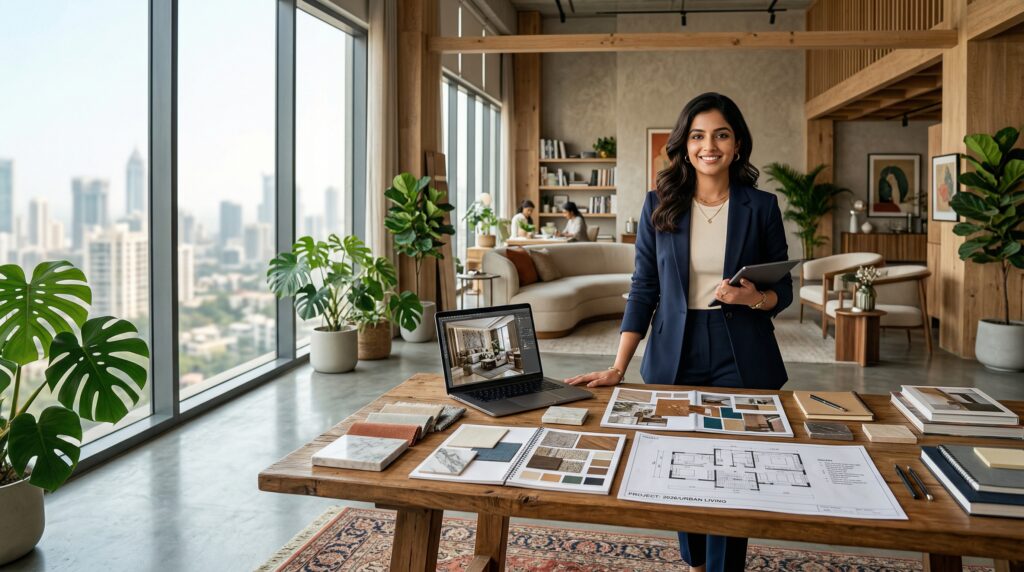
India’s interior design industry was valued at USD 36.89 billion in 2025 — and it is on track to nearly double to USD 74.73 billion by 2034, growing at a CAGR of 8.16% (IMARC Group, 2025). That kind of expansion does not happen quietly. It is being driven by a wave of urban housing projects, a booming commercial real estate sector, and a generation of homeowners who have grown up watching design transformation shows and scrolling through aesthetically curated Instagram feeds.
For a student weighing creative career options, this is one of the most important numbers to understand: the demand for professionally trained interior designers in India is not a trend. It is a structural shift.
This guide covers the full scope of interior designing in India — what career paths actually look like, what sectors are growing fastest, realistic salary expectations at every stage, and how to position yourself to take advantage of the opportunities ahead.
What the Scope of Interior Designing in India Looks Like in 2026
Interior design is more than arranging furniture or choosing paint colours. It is the discipline that determines how people feel inside a space — how productive, how comfortable, how safe. That makes it indispensable across virtually every built environment: homes, offices, hospitals, hotels, retail stores, and film sets.
India’s urbanisation story is the backbone of demand. By 2030, over 600 million Indians will live in cities (Ministry of Housing, 2023), requiring millions of new residential and commercial spaces — all of which need to be designed. The real estate sector is also moving upmarket. Buyers and tenants are increasingly willing to pay for professionally designed spaces, which has shifted interior design from a luxury service to a mainstream one.
Some data points that illustrate the scope clearly:
- India is on track to become the third largest construction market globally by 2030, with USD 1.4 trillion in projected construction output (Global Construction Perspectives)
- The organised home interior segment (tech platforms like Livspace, Homelane, etc.) grew 23% YoY in FY25
- Residential design alone employs approximately 45% of all interior designers in India, and demand is growing at 6% annually
- The commercial and hospitality sectors combined account for another 35% of the market
The point is simple: there is no shortage of work. The shortage is in qualified, well-trained designers.
Career Paths in Interior Design: What Your Options Actually Are
One of the most common misconceptions about interior design is that it means one thing. In practice, it branches into highly distinct specialisations — and knowing where you want to focus will shape which skills you build and which jobs you pursue.
Residential Interior Designer
This is the largest segment by employment and the one most people associate with the profession. Residential designers work on apartments, independent homes, villas, and large housing developments. You are working directly with families to translate their vision — and their budget — into liveable spaces.
The work involves space planning, material selection, furniture layout, colour schemes, lighting design, and coordination with contractors. As platforms like Livspace and Homelane have scaled across 50+ cities, they have also standardised and created structured career tracks for fresh graduates: design consultant roles with training pathways, fixed project pipelines, and performance-based growth.
Entry-level residential designers at organised platforms typically start at ₹3–4.5 LPA, while experienced professionals managing multiple projects earn ₹7–12 LPA.
Commercial Interior Designer
Commercial design covers offices, co-working spaces, retail stores, banks, educational institutions, and corporate campuses. It requires a different sensibility from residential work — the focus shifts from personal expression to functional efficiency, brand alignment, and employee well-being.
Post-pandemic, corporate India has redesigned what offices mean: hybrid-ready layouts, biophilic design elements, wellness zones, and activity-based working (ABW) environments. Demand for commercial designers who understand these frameworks grew 20% annually between 2022 and 2025 (Industry Outlook Report, Novatr).
This is also the segment with some of the largest project values — a single corporate campus or large retail chain rollout can run into crore-scale budgets, and senior commercial designers on such projects command ₹8–18 LPA.
Hospitality Interior Designer
Hotels, resorts, restaurants, spas, and entertainment venues form the hospitality design niche — one of the highest-profile and highest-paying segments in the industry. India’s hospitality sector is expanding rapidly: 50,000+ hotel rooms are expected to be added across the country by 2030, and international hotel chains entering tier-2 cities need design teams who understand both global standards and local aesthetics.
Hospitality designers work closely with architects, brand managers, and operations teams to create guest experiences that are cohesive, memorable, and operationally practical. The skills required include understanding material durability (high-traffic spaces demand different specifications than residential ones), acoustics, lighting psychology, and brand identity translation into spatial design.
Experienced hospitality designers in India earn ₹8–15 LPA; those working with international hotel groups or luxury resort developers can earn significantly more.
Healthcare and Wellness Interior Designer
Healthcare design is the field’s fastest-growing emerging niche. The logic is evidence-based: research consistently shows that well-designed hospitals reduce patient stress, improve recovery times, and reduce medication errors. India is investing heavily in healthcare infrastructure — the sector is projected to reach USD 638 billion by 2025 (IBEF) — and interior designers who understand evidence-based design principles, infection control requirements, wayfinding systems, and universal accessibility are increasingly in demand.
This is a specialisation worth considering for designers who want both social impact and career differentiation — most graduates are not trained for it, which creates real opportunity.
Exhibition and Set Designer
Museums, galleries, trade show booths, film sets, theatre productions, and cultural exhibitions all require designers who can conceptualise and execute immersive spatial experiences, often under tight timelines and production constraints. This is a niche that suits designers who are drawn to storytelling through space, and who are comfortable working across creative and technical teams.
In India’s growing media and entertainment industry — with streaming platforms expanding production, events-led marketing growing, and international exhibitions coming to Indian cities — this niche has seen quiet but sustained growth. Pay varies widely based on project scale, but experienced set designers working with production houses earn ₹5–12 LPA.
Sustainable and Green Interior Designer
Sustainable design has moved from optional feature to client requirement across the higher-end market. LEED certification, use of eco-friendly materials, energy-efficient lighting systems, passive cooling strategies, and responsible sourcing are now standard expectations from corporate clients and premium residential buyers.
Sustainable design consultants command premium billing, and the intersection of design knowledge with environmental science credentials is one of the strongest differentiating moves an interior designer can make in 2026.
Kitchen and Bathroom Design Specialist
Kitchen and bathroom design has become a distinct professional niche, driven by the premium modular kitchen and bathroom fittings market growing at 12–15% annually in India. Companies like IKEA, Hettich, Sleek, and Godrej Interio have created dedicated design consultant roles that are well-paying and structured.
Interior Designer Salary in India (2026): What You Can Actually Expect
| Experience Level | Annual Salary (INR) | Monthly Range |
|---|---|---|
| Entry-Level (0–2 years) | ₹2.5 – 4.5 LPA | ₹20,000 – ₹37,500 |
| Mid-Level (3–5 years) | ₹5 – 8 LPA | ₹41,000 – ₹66,000 |
| Senior Designer (6–10 years) | ₹8 – 15 LPA | ₹66,000 – ₹1,25,000 |
| Principal / Lead Designer | ₹15 – 24 LPA | ₹1,25,000 – ₹2,00,000 |
| Freelance (per project) | ₹30,000 – ₹2,00,000+ | Varies by scope |
Sources: Glassdoor India, Shiksha.com, Novatr Industry Survey 2025
A few factors that significantly push salaries upward:
Specialisation: Designers with certifications or demonstrated expertise in healthcare, sustainable design, or hospitality design consistently earn 20–35% more than generalists at the same experience level.
City: Mumbai, Bengaluru, Delhi NCR, and Hyderabad command the highest pay. Bengaluru, in particular, has become a hub for high-end residential and tech-sector commercial design, making it one of the best markets for interior designers in India.
Portfolio quality: In interior design, your portfolio is your resume. Designers who have documented, well-photographed project portfolios attract better opportunities regardless of years of experience.
Platform vs. independent studio vs. freelance: Organised platforms (Livspace, Homelane) offer structured growth but standardised pay. Independent design studios offer more creative latitude and often higher project-based earnings for experienced designers. Freelance income is highly variable — experienced freelancers in premium residential or corporate markets can earn ₹1.5–2 lakh per project.
Top Sectors Hiring Interior Designers in India
Understanding which sectors are actively hiring — and growing — helps you focus your career positioning.
Real Estate and Housing Developers: Companies like Sobha, Prestige, DLF, and Brigade Groups are increasingly building interior design capabilities in-house or on long-term retainer, particularly for premium and luxury projects.
Interior Design Platforms: Livspace (50+ cities, 23% FY25 revenue growth), Homelane (22% FY25 growth, expanding franchise network), and Pepperfry Interiors are the largest structured employers for fresh graduates, offering training, mentorship, and clear career progression.
Architecture and Design Firms: Firms like Morphogenesis, Sanjay Puri Architects, and thousands of boutique studios across metro cities offer roles for interior designers who want project variety and design-led work.
Hospitality Groups: ITC Hotels, Marriott India, Hyatt India, and independent luxury resorts maintain or contract interior design talent for ongoing projects and renovations.
Corporate Real Estate (CRE) and Facility Management Firms: Companies like JLL, CBRE, and Colliers India manage corporate design and fit-out projects and hire in-house design teams.
Furniture and Materials Companies: Godrej Interio, IKEA India, Asian Paints, and kitchen and bathroom fittings brands all employ interior designers in product development, showroom design, and customer-facing design consulting roles.
Specialisations That Are Redefining Interior Design in India
Beyond the broad sectors, several emerging specialisations are quietly generating some of the highest-paid and fastest-growing roles in the field:
Lighting Design: Lighting is one of the most technically demanding and conceptually powerful tools in interior design — and a significantly underserved specialisation in India. Dedicated lighting consultants can charge premium fees and work across residential, hospitality, retail, and landmark public projects.
Acoustic Design: Office design, home theatres, co-working spaces, and hospitality venues all require acoustic planning. As hybrid working becomes the norm, designing for sound management has become a serious discipline.
Colour Consultancy: Large paint companies, real estate developers, and commercial fit-out firms retain colour consultants who combine design sensibility with an understanding of colour psychology and brand identity.
Wayfinding and Environmental Graphic Design: This sits at the intersection of interior design and visual communication — designing the signage, spatial cues, and orientation systems that guide people through hospitals, airports, campuses, and retail environments.
Universal Design / Accessibility Consulting: As India’s disability rights legislation (RPwD Act, 2016) becomes more actively enforced in commercial and public buildings, designers who understand universal design principles have a growing and underserved market.
Skills That Separate Good Interior Designers from the Rest
Technical skill in spatial planning and design software is the baseline — not the differentiator. The skills that accelerate careers are:
3D Visualisation and BIM: AutoCAD, SketchUp, 3ds Max, Revit, and increasingly, AI-assisted rendering tools like Midjourney and Adobe Firefly for rapid concept visualisation. Designers fluent in BIM (Building Information Modelling) are significantly more employable in architecture and large commercial projects.
Material Knowledge: Knowing the performance characteristics, pricing bands, and sourcing channels for flooring, upholstery, wall treatments, lighting fixtures, and furniture is practical expertise that clients and employers value highly.
Project and Budget Management: Interior design projects invariably involve contractors, vendors, timelines, and budgets. Designers who can manage these competently — not just the design part — move into project leadership roles faster.
Client Communication and Presentation: The ability to translate design ideas into presentations that non-designers can understand and respond to emotionally is a skill that distinguishes professionals who get repeat work and referrals from those who don’t.
Sustainability Literacy: Understanding green building standards (IGBC Green Homes, LEED), eco-material certification, and energy efficiency principles is increasingly expected for any mid-to-senior position.
Frequently Asked Questions About the Scope of Interior Designing in India
Is interior designing a good career in India in 2026?
Yes — it is one of the more resilient creative careers because it is tied to fundamental economic drivers: real estate, urbanisation, and consumer spending on quality of life. The industry’s 8%+ CAGR means structural demand growth rather than cyclical opportunity. That said, it is a competitive field where portfolio and specialisation matter significantly.
What is the starting salary of an interior designer in India?
Entry-level interior designers in India earn between ₹2.5 and ₹4.5 LPA, with graduates placed at organised platforms like Livspace or Homelane often starting in the ₹3–3.5 LPA range with structured growth paths. Freelance income in the early years is variable and typically supplements a primary role rather than replacing it.
Which cities in India offer the best opportunities for interior designers?
Bengaluru, Mumbai, Delhi NCR, Hyderabad, and Pune are the strongest markets in terms of volume of opportunities and salary levels. Bengaluru is particularly strong for high-end residential and tech-sector commercial design. Tier-2 cities (Ahmedabad, Jaipur, Kochi, Chandigarh) are growing fast as the organised interior design market expands beyond metros.
What is the future scope of interior designing in India?
The outlook is strong. Key growth drivers include continued urbanisation, premium residential housing growth, the expansion of organised players like Livspace into 100+ cities, growth in the hospitality and healthcare sectors, and increasing corporate adoption of evidence-based workplace design. Specialisations in sustainable design, healthcare design, and smart home technology are particularly well-positioned for the next decade.
Can interior designers work freelance in India?
Yes, and many successful designers operate as independent consultants after gaining 3–5 years of experience. Experienced freelancers managing premium residential or corporate projects earn ₹30,000–₹2,00,000 or more per project. The key requirements are a strong portfolio, reliable contractor relationships, and a client pipeline — typically built through referrals.
Do I need a degree to become an interior designer in India?
A formal degree — B.Sc. in Interior Design, B.Des., or a Diploma from a recognised institution — is strongly recommended. It provides structured knowledge in spatial planning, materials, technical drawing, and design history that is hard to acquire informally. It also signals credibility to employers and clients, and is a prerequisite for membership in professional bodies like the Institute of Indian Interior Designers (IIID). If you are exploring what a formal qualification looks like, you might find it useful to understand why studying interior design formally matters.
What are the best courses to pursue for a career in interior design in India?
A B.Sc. in Interior Design is one of the most comprehensive undergraduate options, combining spatial planning, material science, drawing, and design history. B.Des. programmes offer a broader design education. Diploma programmes (2–3 years) are faster entry routes that suit students who want to start working sooner. The right choice depends on your career goals, timeline, and budget.
How to Set Yourself Up for a Successful Interior Design Career
If you are currently deciding whether to pursue interior design and what steps to take, here is a clear path forward:
Step 1: Get formally trained. Understanding how to become an interior designer in India starts with a recognised qualification. Look for institutions that offer exposure to both traditional design principles and current digital tools (AutoCAD, SketchUp, 3ds Max, Revit).
Step 2: Understand design fundamentals deeply. Space planning, proportion, colour theory, material behaviour, and lighting are not introductory topics to skim — they are the foundation of every good design decision you will make for the rest of your career. A thorough understanding of the principles of interior design will distinguish you from graduates who can use the software but cannot design.
Step 3: Build a portfolio during your studies. Every project you complete — academic or otherwise — should be documented, styled, and photographed. Start building your portfolio in Year 1, not after graduation.
Step 4: Choose a specialisation early. You do not need to be a specialist as a fresher, but identifying an area of genuine interest — hospitality, sustainable design, commercial, healthcare — and seeking internship or project exposure in that area will accelerate your career differentiation.
Step 5: Gain practical experience through internships. There is a knowledge gap between academic training and client-facing professional work that only hands-on experience closes. The process of starting a career in interior design begins with internships — they are not optional extras, they are the bridge to your first role.
Step 6: Join professional networks. IIID (Institute of Indian Interior Designers) membership, participation in design exhibitions, and engagement with the broader professional community opens doors to mentorship, referrals, and project opportunities that are invisible to those who work in isolation.
The Scope Is Wide — The Opportunity Is Yours to Shape
The scope of interior designing in India in 2026 is genuinely broad. The market is large, growing, and structurally supported by forces that are not going away: urbanisation, real estate growth, premiumisation, and a growing public understanding of what good design does to quality of life.
What determines whether that scope translates into a career that is financially rewarding and creatively fulfilling is not the market — it is the quality of your training, the specificity of your skills, and the intentionality with which you build your professional identity.
If you are serious about a career in interior design, the first step is getting the right foundation. IIFT Bangalore offers a B.Sc. in Interior Design & Decoration specifically designed to prepare students for the professional demands of the industry — combining design principles, technical skills, and practical exposure in a programme built around career outcomes.
Explore the programme or connect with IIFT Bangalore’s admissions team to understand how it fits your goals.
Sources: IMARC Group India Interior Design Market Report 2025; Global Construction Perspectives; Novatr Interior Design Industry Outlook 2025; Glassdoor India Salary Data; IBEF Healthcare Sector Report; Mordor Intelligence India Interior Design Market; Ministry of Housing and Urban Affairs.