

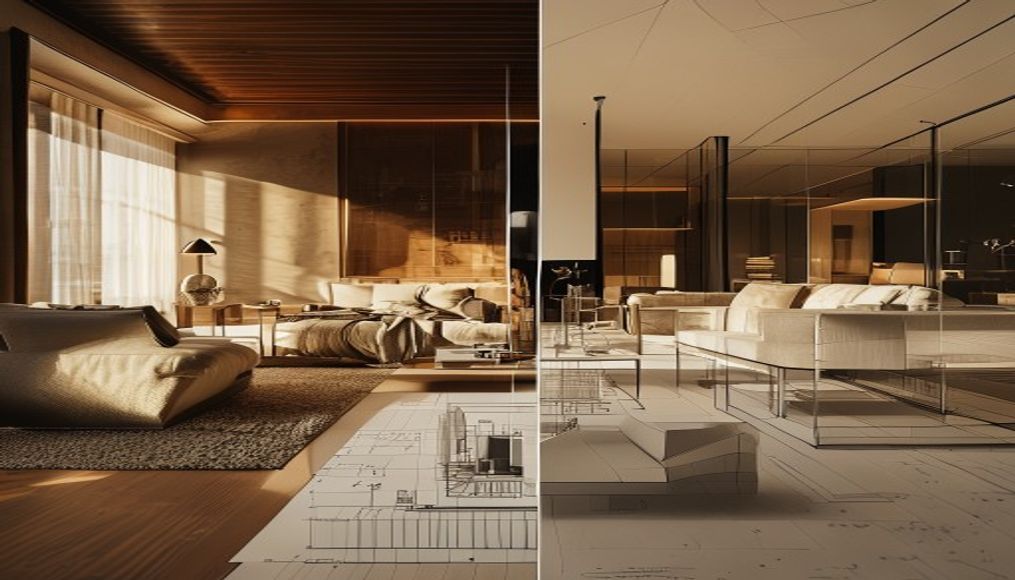
Every year, thousands of students in India finish their 12th boards and face a question that no one in their family can quite answer: interior design or architecture? Both sound creative. Both involve designing spaces. Both lead to careers that feel meaningful. But the actual day-to-day work, the study path, the skills you need, the time investment, and the career trajectory — they are fundamentally different.
This guide cuts through the confusion with a direct, side-by-side comparison of both careers — covering course eligibility, duration, what you actually do on the job, salary, scope in India’s current market, and most importantly, a framework to help you figure out which one fits you.
What Is the Difference Between Interior Design and Architecture?
In plain terms: an architect designs buildings — the structure, the shell, the systems that make a building stand and function. An interior designer works within that shell — planning how the inside of a space looks, feels, and functions for the people who use it.
- Architects deal with structure, building codes, civil systems, and large-scale construction.
- Interior designers deal with space planning, materials, lighting, furniture, colour, and user experience inside a space.
- Architects typically work on a building before it is built. Interior designers often work during and after construction.
- In India, architects must register with the Council of Architecture (CoA) to practise. Interior designers have no mandatory licensing requirement.
- An architect can legally offer interior design services. An interior designer cannot legally practise architecture.
In simple terms: if you are drawn to how a building comes to exist — its bones, structure, and relationship to the city around it — architecture is your path. If you are drawn to how a space feels to live and work in — its textures, light, layout, and emotion — interior design is where you belong.
Course Comparison: Eligibility, Duration, and What You Study
This is where the two careers diverge most sharply — and where most students get surprised. The entry requirements for architecture are stricter than most people realise, while interior design is genuinely accessible from any stream.
Architecture (B.Arch)
A Bachelor of Architecture (B.Arch) is a five-year undergraduate programme divided into ten semesters. It is one of the longer undergraduate programmes in India — comparable to engineering — and with good reason: architects are legally responsible for the structural safety of buildings they design.
Eligibility: You must have completed Class 12 from the Science stream with Physics, Chemistry, and Mathematics as compulsory subjects, with a minimum of 50% aggregate marks. Students from Arts or Commerce streams are not eligible for B.Arch. This is a hard requirement set by the Council of Architecture.
Entrance exams: NATA (National Aptitude Test in Architecture), conducted by the Council of Architecture, is mandatory for admission to any architecture college in India. Many institutions also accept JEE Main Paper 2. NATA tests your drawing ability, observation skills, and mathematical reasoning — not just rote academics.
What you study: Over five years, you cover architectural design, structural systems, environmental science, building construction technology, history of architecture, urban planning, computer-aided design, and building codes. The final year typically involves a thesis project — a full architectural design solution for a real or hypothetical brief.
Course fees: Government architecture colleges charge approximately ₹50,000 to ₹2 lakh per year. Private colleges range from ₹1 lakh to ₹6 lakh per year, with total programme costs across five years running from ₹7.5 lakh to over ₹26 lakh at premium private institutions.
Interior Design (B.Sc. / Diploma / B.Des)
Interior design programmes come in multiple formats in India — from a three-year B.Sc. degree to one-year diplomas and six-month certificate courses. The flexibility of the qualification pathway is one of interior design’s biggest advantages as a career entry point.
Eligibility: For a B.Sc. in Interior Design, you need to have completed Class 12 from any stream — Science, Arts, or Commerce — with at least 50% aggregate marks. Maths is not a requirement. This means students who have chosen the Humanities or Commerce path are fully eligible, which opens the door that architecture closes.
Entrance exams: Most interior design programmes in India do not require a mandatory national entrance exam. Some institutions hold their own aptitude and portfolio-based assessments, but admission is generally more accessible than architecture.
What you study: A B.Sc. in Interior Design covers space planning, principles and elements of design, colour theory, material and fabric studies, lighting design, furniture design, AutoCAD, 3ds Max, architectural detailing, and client management. Good programmes include live project work and internships with design firms.
Course fees: A B.Sc. in Interior Design typically costs between ₹2.3 lakh and ₹6.2 lakh for the full three-year programme. Diploma courses range from ₹15,000 to ₹2.5 lakh depending on duration and institution.
IIFT Bangalore offers a three-year B.Sc. in Interior Design and Decoration affiliated to Bangalore University, along with a one-year Diploma and a six-month online certificate course. The programmes include hands-on training in AutoCAD, 3ds Max, and Photoshop, along with a one-month internship with leading design firms — giving students practical portfolio-ready experience before they graduate. Explore IIFT’s interior design programmes here.
Side-by-Side Comparison: Interior Design vs Architecture
| Factor | Interior Design | Architecture (B.Arch) |
|---|---|---|
| Course Duration | 3 years (B.Sc.) / 1 year (Diploma) / 6 months (Certificate) | 5 years (B.Arch) |
| Stream Eligibility | Any stream (Science, Arts, Commerce) | Science only (Maths compulsory) |
| Entrance Exam | None mandatory (institution-specific tests) | NATA mandatory (+ JEE Main Paper 2 for top colleges) |
| Typical Course Fees | ₹2.3L – ₹6.2L (full B.Sc.) | ₹7.5L – ₹26L+ (full B.Arch) |
| Licensing Required | No mandatory licence | Council of Architecture registration mandatory |
| Fresher Salary | ₹2.5 – ₹4 LPA | ₹2 – ₹4 LPA |
| Mid-Career Salary | ₹5 – ₹8 LPA | ₹4 – ₹12 LPA |
| Senior / Business Owner | ₹20 – ₹45 LPA+ | ₹14 – ₹22 LPA+ (salaried); higher if independent practice |
| Primary Work Scale | Interiors of residential, commercial, hospitality spaces | Entire buildings, urban infrastructure, large-scale projects |
| Client Interaction | Frequent and direct (home owners, businesses) | Moderate (more team and contractor coordination) |
| Can Practise the Other? | Cannot practise architecture legally | Can legally offer interior design services |
| Best For | Students from any stream who love aesthetics, materials, and human-centred design | Science stream students who love structure, engineering, and city-scale thinking |
| Verdict | Faster to qualify, broader stream eligibility, booming market — ideal for students who want to start designing spaces sooner | Longer, more technical path with stronger regulatory authority — ideal for students committed to structural design and large-scale projects |
What Do They Actually Do at Work?
Beyond the classroom, the real difference between these two careers shows up in day-to-day work. Understanding what a typical project looks like in each field helps you judge which one you would actually enjoy doing for years.
A Day in the Life of an Interior Designer
An interior designer’s work is centred on the human experience of a space. A typical project might begin with a client consultation — understanding how the family lives, what their daily routines are, what they find beautiful, and what their budget allows. From there, the designer develops a concept: a mood board that captures the visual direction, material choices, a colour palette, and a lighting plan.
On any given day, an interior designer might be finalising space plans on AutoCAD in the morning, visiting a furniture showroom to assess fabric samples in the afternoon, and presenting 3D renders to a client over video call in the evening. Client relationships are close and ongoing — interior design is a deeply personal service because you are literally shaping the space someone lives or works in every day.
Interior designers in India work across residential homes, luxury apartments, corporate offices, retail stores, hotels, restaurants, hospitals, and event spaces. Specialisation matters — a designer who focuses on hospitality interiors builds a reputation and a rate card that general residential designers cannot easily match.
A Day in the Life of an Architect
An architect’s work operates at a larger and more technical scale. A typical project might involve designing an entire residential complex, a commercial office building, or a public institution. The early phase is about site analysis — studying the topography, climate conditions, orientation to sun and wind, and surrounding urban context before a single line is drawn.
On a typical day, an architect might review structural drawings with a civil engineer, work through a building’s mechanical and electrical systems with service consultants, present design documentation to a client, or visit a construction site to verify that the work matches the approved drawings. The teams are larger — architects regularly coordinate with structural engineers, landscape architects, urban planners, and contractors.
The project timelines are longer. A building that takes two years to construct might have taken another two years of design and approvals before ground was broken. This slower pace is intentional — errors in architectural design can have structural consequences that errors in interior design do not.
Career Scope and Market Opportunity in India
Both careers have strong futures in India, but the drivers and timelines look different. Understanding the market context helps you make a decision that holds up not just today but five to ten years from now.
Interior Design: A Market Growing Faster Than Most People Realise
India’s interior design industry was valued at USD 36.89 billion in 2025 and is projected to reach USD 74.73 billion by 2034 — a compound annual growth rate of 8.16% (IMARC Group, 2025). That is not a small market quietly chugging along. That is a sector set to nearly double in under a decade.
Several forces are driving this growth simultaneously. India’s urban population is projected to reach 600 million by 2036, and every one of those new urban households is a potential interior design project. The government’s PM Awas Yojana Urban 2.0 has committed ₹10 lakh crore to address housing for one crore urban families — a programme that will directly generate massive downstream demand for interior finishing and design services. Meanwhile, the renovation and remodelling segment is growing at a 13.35% CAGR, driven by office retrofits and premium residential upgrades.
Beyond residential work, interior designers are finding growing opportunities in healthcare design (India’s healthcare sector is projected to reach USD 638 billion, and hospitals increasingly require designers who understand wayfinding, infection control, and patient wellbeing), hospitality, retail, and co-working spaces. Bengaluru, in particular, has become a major hub for high-end residential and tech-sector commercial interior design.
For students considering this career, the IIFT blog has a more detailed breakdown of the scope of interior designing in India across sectors and cities.
Architecture: Strong Foundations, Longer Runway
Architecture in India is supported by sustained investment in infrastructure — airports, metro systems, smart cities, affordable housing projects, and commercial real estate. The profession carries legal authority that interior design does not: only a registered architect can sign off on building plans for statutory approvals. This regulatory moat means that qualified architects always have a defined role in any major construction project.
However, the career trajectory is slower at the start. A fresh B.Arch graduate typically joins a firm as a junior architect, spending the first few years developing detailed drawings and learning to navigate the gap between design intent and construction reality. Senior-level roles and independent practice — where the real earnings and creative control lie — tend to arrive after ten or more years.
For students who want to understand how the two careers interconnect, the IIFT guide on how to become an interior designer in India covers the qualification pathways in detail.
Salary: What You Can Realistically Expect
One of the most searched questions on this topic is salary — and the honest answer is that at the entry level, interior designers and architects earn remarkably similar amounts. The difference grows with experience and specialisation, not at the starting line.
Interior designers typically start at ₹2.5 to ₹4 LPA as freshers. With three to seven years of experience, mid-level designers earn ₹5 to ₹8 LPA. Senior designers and creative leads with a decade or more of experience — particularly those specialising in luxury residential, hospitality, or healthcare — can earn ₹20 to ₹45 LPA. Designers who transition into running their own studios or consultancies can command project fees that take earnings well beyond a salaried ceiling. The average interior designer in India earns approximately ₹23,279 per month as of 2026 (Indeed India data).
Architects typically start at ₹2 to ₹4 LPA as freshers. Mid-career architects with five to nine years of experience earn ₹4 to ₹12 LPA in firm roles. Senior architects in metro cities — Mumbai, Delhi, Bengaluru — can command ₹14 to ₹22 LPA in salaried positions. Independent architects who build a strong project portfolio and client base can earn considerably more. The average architect in India earns approximately ₹25,539 per month (Indeed India, 2026).
The key insight: both careers pay similarly at the start, but interior design offers a faster path to high earnings for those who specialise and build strong client networks, while architecture offers a more defined progression through firm hierarchies and the potential for landmark project credit.
For students who want to understand the fundamentals underpinning both careers, the IIFT guide on interior design principles and fundamentals gives useful context on what professional design training actually covers.
Career Paths Within Each Field
Neither career is a single track. Understanding the range of paths available within each field gives a more accurate picture of what your future could look like.
Interior Design career paths include: residential interior designer, commercial space designer, hospitality and hotel design specialist, retail design consultant, healthcare interior designer, sustainable design specialist, set designer for film and theatre, visual merchandiser, interior styling for real estate, and corporate interior design lead. Each of these specialisations commands different rates and attracts different client types.
Architecture career paths include: residential architect, commercial architect, urban planner, landscape architect, sustainable or green building specialist, heritage conservation and restoration architect, project architect in a large firm, and independent practitioner. Some architects also move into academia, urban policy, or real estate development over time.
For students who want to explore interior design careers in more depth before deciding, the IIFT article on how to start a career in interior design walks through entry points, specialisations, and what early career looks like in practice. If you are also weighing how interior design compares with other design disciplines, the guide on what to expect from a B.Sc. in Interior Design in India covers the course experience in detail.
The Skills Each Career Develops — and Demands
Knowing what skills each career builds — and what aptitudes it assumes you already have — is useful when you are trying to map yourself to one of these paths.
Interior designers develop: spatial planning and visualisation, colour theory and materials knowledge, AutoCAD and 3D visualisation software (3ds Max, SketchUp, Revit), client communication and project management, vendor and contractor coordination, lighting design, and trend awareness. Strong communication skills are essential — interior design is a client-facing career from day one.
Architects develop: structural and systems thinking, technical drawing and documentation, knowledge of building codes and regulations, project management at scale, engineering coordination, environmental and sustainability design, and urban analysis. Strong mathematical and analytical thinking underpins the whole curriculum.
The honest question to ask yourself: which set of skills do you already have inklings of? The career you choose will deepen what you bring — but it cannot easily replace what is not there. A student who struggles with mathematical reasoning will find B.Arch a constant uphill climb. A student who finds technical engineering detail draining will find architecture’s five years exhausting in a way that interior design never would be.
Which Career Is Right for You? A Decision Framework
Rather than giving a generic “both are great” answer, here is a structured way to think through this decision based on factors that actually matter to your situation.
Choose Interior Design If:
- You studied Arts or Commerce in Class 12. Architecture is simply not an option without Maths and the Science stream. Interior design welcomes students from every background.
- You want to start working sooner. A three-year B.Sc. gets you into the field two years faster than a five-year B.Arch. In a field driven by portfolio and experience, those two years matter.
- You are drawn to aesthetics, materials, and the sensory experience of spaces. Interior design is fundamentally about how people feel inside a space. If you think about lighting, texture, and colour the way others think about logistics, this is your home.
- You want close, direct client relationships. Interior designers work intimately with clients — understanding their lives, tastes, and needs. If you enjoy that human-centred, consultative side of work, interior design rewards it directly.
- You want to run your own business. Interior design studios are among the more accessible creative businesses to launch. Startup costs are lower than an architectural practice, and the market is vast. Many successful interior designers are independent consultants or studio founders within five to seven years of graduating.
- You are interested in the current growth sectors. Hospitality, healthcare, luxury residential, and co-working spaces are all generating high demand for skilled interior designers right now. This is the right moment to enter the field.
Choose Architecture If:
- You studied Science with Maths in Class 12. You have the eligibility window. Architecture requires it; use it if the field calls you.
- You are drawn to how buildings come to exist. Structure, construction systems, materials science, and the relationship between a building and its environment — if these excite you, architecture is the right match.
- You think at the scale of cities. Urban planning, smart city design, public infrastructure, sustainable architecture — these are architecture-scale ambitions that interior design cannot satisfy.
- You want legal authority over the built environment. Only registered architects can approve building plans in India. If you want that formal professional standing and the responsibility that comes with it, architecture is the path.
- You are comfortable with a longer journey. Five years of study plus several years of firm experience before independent practice is realistic — and rewarding for those who are patient and committed.
- You want to work on landmark, large-scale projects. Airports, institutions, commercial towers, and cultural buildings — these are architecture’s domain. If that kind of work energises you, the investment in B.Arch makes sense.
If You Are Genuinely Unsure
Consider this: if you are unsure whether you need Maths-level technical rigour or aesthetics-led creative thinking, ask yourself which you spend more time doing voluntarily. Do you sketch rooms, rearrange furniture, and think about how spaces could feel better? Or do you draw structures, build models, and think about how buildings are put together? Your honest answer is more reliable than any quiz or ranking.
It is also worth knowing that some of the best interior designers started out curious about architecture before realising that the human-scale, tactile world of interiors was where their real passion lived. The opposite is rarer — architecture’s five-year, Maths-based path tends to self-select students with a strong technical commitment.
Common Mistakes Students Make When Choosing Between These Careers
These are the most common misjudgements that lead students to regret their choice — or delay making one at all.
Assuming interior design is easier or less serious than architecture. Interior design is technically demanding in its own way — space planning, structural constraints, material specifications, building codes for interior works, and client management are all skills that take years to develop. The absence of a mandatory entrance exam does not mean the career is lightweight.
Thinking architecture pays more at every stage. The salary comparison shows that interior designers and architects start at nearly identical pay, and interior designers who specialise and build strong networks often out-earn architects at the senior level — especially in luxury and hospitality design.
Choosing architecture because it “sounds more impressive.” If you do not genuinely want to engage with structural systems, building codes, and five years of highly technical study, you will struggle — and likely switch midway through, which is far more costly than choosing the right path upfront.
Underestimating the stream restriction for architecture. Many students from Arts or Commerce backgrounds are genuinely drawn to architecture’s aesthetic ambitions but cannot pursue B.Arch. Interior design is not a consolation prize in this case — it is the right door for how you got here.
Not accounting for course duration in your financial planning. Five years of B.Arch versus three years of B.Sc. Interior Design is a two-year difference in time-to-earning. For students from families where the cost of extended education is a real consideration, this matters significantly.
Overlooking the practical limitations and pitfalls of each path. Architecture has a failure point that most students don’t anticipate: the NATA exam tests spatial reasoning and freehand drawing ability — not just academics. Students who have not practised drawing consistently often underestimate this barrier and treat it as a common mistake they can fix last-minute. Interior design has a different drawback: without strong networking and business development skills, many graduates find that the freelance side of the career does not build the way they expected. The hidden cost here is time — building a client base typically takes two to three years of active effort after graduation. Understanding these pitfalls before you commit saves significant time and money.
Author’s Note
This guide was written by the academic and content team at IIFT Bangalore, a design institution with over two decades of experience preparing students for careers in interior design and fashion. IIFT has guided thousands of students through exactly this career decision — and this article reflects what we have learned works when helping students cut through the noise and choose the right path for their skills, interests, and circumstances.
Frequently Asked Questions
Can I pursue interior design after Commerce or Arts in Class 12?
Yes. Interior design programmes in India accept students from any stream — Science, Commerce, or Arts — as long as they have completed Class 12 with a minimum of 50% aggregate marks. Maths is not a requirement. This is one of the most important distinctions between interior design and architecture, which is restricted to Science stream students.
Is interior design easier than architecture?
Not easier — different. Architecture is technically heavier, with a strong emphasis on mathematics, structural engineering, and building systems. Interior design demands deep aesthetic sensibility, material knowledge, and client management skills. Both require rigorous training and years of practice to master. The right one is whichever matches your natural aptitude and interests — not whichever seems less demanding.
Which has better scope in India — interior design or architecture?
Both have strong scope, but the drivers are different. India’s interior design market is projected to grow from USD 36.89 billion in 2025 to USD 74.73 billion by 2034 — fuelled by urbanisation, rising incomes, and government housing programmes. Architecture benefits from infrastructure investment and has a regulatory advantage: only registered architects can sign off on building plans. Interior design offers faster access to a booming market; architecture offers longer-term regulatory authority on large-scale projects.
Do architects earn more than interior designers in India?
At the entry level, salaries are nearly identical — both typically start at ₹2 to ₹4 LPA. The gap widens with experience and specialisation. Mid-career architects in firms can earn up to ₹12 LPA; senior architects in metro cities earn ₹14 to ₹22 LPA. Interior designers who specialise in luxury or hospitality design, or who build their own studios, can earn ₹20 to ₹45 LPA or more at the senior level. Neither career has a definitive earnings advantage — the higher earner depends on specialisation and entrepreneurial drive.
How long does it take to become a professional interior designer vs architect?
An interior designer can complete a B.Sc. in three years and begin working professionally thereafter. An architect needs five years for the B.Arch degree, after which registration with the Council of Architecture is required before independent practice. The two-year difference in study duration translates to earlier entry into the workforce and earlier career earnings for interior designers.
Can an architect work as an interior designer?
Yes. An architect can legally offer interior design services in India, and many do — particularly for projects where they are already engaged in the building’s design. However, an interior designer cannot legally practise architecture or sign off on structural building plans. This legal asymmetry means architecture provides more career flexibility in theory, though most architects tend to focus on their core discipline in practice.
What entrance exam do I need for interior design courses?
Most interior design programmes in India do not require a mandatory national entrance exam. Some institutions — particularly private design schools — conduct their own aptitude tests or portfolio reviews. For the B.Sc. Interior Design at IIFT Bangalore, admissions are based on eligibility criteria and seat availability. Architecture, by contrast, requires NATA (National Aptitude Test in Architecture), which is mandatory for all B.Arch admissions across India.
Is IIFT Bangalore’s interior design programme affiliated to a university?
Yes. The B.Sc. in Interior Design and Decoration at IIFT Bangalore is affiliated to Bangalore University. The three-year programme covers design fundamentals, space planning, materials, software training (AutoCAD, 3ds Max, Photoshop), and includes a one-month internship with industry firms. Admissions for 2026 are currently open.
The Bottom Line
Interior design and architecture are both meaningful, creative, and financially rewarding careers — but they are not interchangeable. The right choice depends on your 12th stream, your aptitude, your timeline, and what genuinely excites you about shaping spaces.
If you studied in the Science stream with Maths and feel drawn to the structural, city-scale world of buildings, architecture is worth the five-year commitment. If you come from any stream and want to work on how spaces feel, look, and function for the people inside them — and want to enter a booming market sooner — interior design is a compelling, substantiv
Every year, thousands of students in India finish their 12th boards and face a question that no one in their family can quite answer: interior design or architecture? Both sound creative. Both involve designing spaces. Both lead to careers that feel meaningful. But the actual day-to-day work, the study path, the skills you need, the time investment, and the career trajectory — they are fundamentally different.
This guide cuts through the confusion with a direct, side-by-side comparison of both careers — covering course eligibility, duration, what you actually do on the job, salary, scope in India’s current market, and most importantly, a framework to help you figure out which one fits you.
What Is the Difference Between Interior Design and Architecture?
In plain terms: an architect designs buildings — the structure, the shell, the systems that make a building stand and function. An interior designer works within that shell — planning how the inside of a space looks, feels, and functions for the people who use it.
- Architects deal with structure, building codes, civil systems, and large-scale construction.
- Interior designers deal with space planning, materials, lighting, furniture, colour, and user experience inside a space.
- Architects typically work on a building before it is built. Interior designers often work during and after construction.
- In India, architects must register with the Council of Architecture (CoA) to practise. Interior designers have no mandatory licensing requirement.
- An architect can legally offer interior design services. An interior designer cannot legally practise architecture.
In simple terms: if you are drawn to how a building comes to exist — its bones, structure, and relationship to the city around it — architecture is your path. If you are drawn to how a space feels to live and work in — its textures, light, layout, and emotion — interior design is where you belong.
Course Comparison: Eligibility, Duration, and What You Study
This is where the two careers diverge most sharply — and where most students get surprised. The entry requirements for architecture are stricter than most people realise, while interior design is genuinely accessible from any stream.
Architecture (B.Arch)
A Bachelor of Architecture (B.Arch) is a five-year undergraduate programme divided into ten semesters. It is one of the longer undergraduate programmes in India — comparable to engineering — and with good reason: architects are legally responsible for the structural safety of buildings they design.
Eligibility: You must have completed Class 12 from the Science stream with Physics, Chemistry, and Mathematics as compulsory subjects, with a minimum of 50% aggregate marks. Students from Arts or Commerce streams are not eligible for B.Arch. This is a hard requirement set by the Council of Architecture.
Entrance exams: NATA (National Aptitude Test in Architecture), conducted by the Council of Architecture, is mandatory for admission to any architecture college in India. Many institutions also accept JEE Main Paper 2. NATA tests your drawing ability, observation skills, and mathematical reasoning — not just rote academics.
What you study: Over five years, you cover architectural design, structural systems, environmental science, building construction technology, history of architecture, urban planning, computer-aided design, and building codes. The final year typically involves a thesis project — a full architectural design solution for a real or hypothetical brief.
Course fees: Government architecture colleges charge approximately ₹50,000 to ₹2 lakh per year. Private colleges range from ₹1 lakh to ₹6 lakh per year, with total programme costs across five years running from ₹7.5 lakh to over ₹26 lakh at premium private institutions.
Interior Design (B.Sc. / Diploma / B.Des)
Interior design programmes come in multiple formats in India — from a three-year B.Sc. degree to one-year diplomas and six-month certificate courses. The flexibility of the qualification pathway is one of interior design’s biggest advantages as a career entry point.
Eligibility: For a B.Sc. in Interior Design, you need to have completed Class 12 from any stream — Science, Arts, or Commerce — with at least 50% aggregate marks. Maths is not a requirement. This means students who have chosen the Humanities or Commerce path are fully eligible, which opens the door that architecture closes.
Entrance exams: Most interior design programmes in India do not require a mandatory national entrance exam. Some institutions hold their own aptitude and portfolio-based assessments, but admission is generally more accessible than architecture.
What you study: A B.Sc. in Interior Design covers space planning, principles and elements of design, colour theory, material and fabric studies, lighting design, furniture design, AutoCAD, 3ds Max, architectural detailing, and client management. Good programmes include live project work and internships with design firms.
Course fees: A B.Sc. in Interior Design typically costs between ₹2.3 lakh and ₹6.2 lakh for the full three-year programme. Diploma courses range from ₹15,000 to ₹2.5 lakh depending on duration and institution.
IIFT Bangalore offers a three-year B.Sc. in Interior Design and Decoration affiliated to Bangalore University, along with a one-year Diploma and a six-month online certificate course. The programmes include hands-on training in AutoCAD, 3ds Max, and Photoshop, along with a one-month internship with leading design firms — giving students practical portfolio-ready experience before they graduate. Explore IIFT’s interior design programmes here.
Side-by-Side Comparison: Interior Design vs Architecture
| Factor | Interior Design | Architecture (B.Arch) |
|---|---|---|
| Course Duration | 3 years (B.Sc.) / 1 year (Diploma) / 6 months (Certificate) | 5 years (B.Arch) |
| Stream Eligibility | Any stream (Science, Arts, Commerce) | Science only (Maths compulsory) |
| Entrance Exam | None mandatory (institution-specific tests) | NATA mandatory (+ JEE Main Paper 2 for top colleges) |
| Typical Course Fees | ₹2.3L – ₹6.2L (full B.Sc.) | ₹7.5L – ₹26L+ (full B.Arch) |
| Licensing Required | No mandatory licence | Council of Architecture registration mandatory |
| Fresher Salary | ₹2.5 – ₹4 LPA | ₹2 – ₹4 LPA |
| Mid-Career Salary | ₹5 – ₹8 LPA | ₹4 – ₹12 LPA |
| Senior / Business Owner | ₹20 – ₹45 LPA+ | ₹14 – ₹22 LPA+ (salaried); higher if independent practice |
| Primary Work Scale | Interiors of residential, commercial, hospitality spaces | Entire buildings, urban infrastructure, large-scale projects |
| Client Interaction | Frequent and direct (home owners, businesses) | Moderate (more team and contractor coordination) |
| Can Practise the Other? | Cannot practise architecture legally | Can legally offer interior design services |
| Best For | Students from any stream who love aesthetics, materials, and human-centred design | Science stream students who love structure, engineering, and city-scale thinking |
| Verdict | Faster to qualify, broader stream eligibility, booming market — ideal for students who want to start designing spaces sooner | Longer, more technical path with stronger regulatory authority — ideal for students committed to structural design and large-scale projects |
What Do They Actually Do at Work?
Beyond the classroom, the real difference between these two careers shows up in day-to-day work. Understanding what a typical project looks like in each field helps you judge which one you would actually enjoy doing for years.
A Day in the Life of an Interior Designer
An interior designer’s work is centred on the human experience of a space. A typical project might begin with a client consultation — understanding how the family lives, what their daily routines are, what they find beautiful, and what their budget allows. From there, the designer develops a concept: a mood board that captures the visual direction, material choices, a colour palette, and a lighting plan.
On any given day, an interior designer might be finalising space plans on AutoCAD in the morning, visiting a furniture showroom to assess fabric samples in the afternoon, and presenting 3D renders to a client over video call in the evening. Client relationships are close and ongoing — interior design is a deeply personal service because you are literally shaping the space someone lives or works in every day.
Interior designers in India work across residential homes, luxury apartments, corporate offices, retail stores, hotels, restaurants, hospitals, and event spaces. Specialisation matters — a designer who focuses on hospitality interiors builds a reputation and a rate card that general residential designers cannot easily match.
A Day in the Life of an Architect
An architect’s work operates at a larger and more technical scale. A typical project might involve designing an entire residential complex, a commercial office building, or a public institution. The early phase is about site analysis — studying the topography, climate conditions, orientation to sun and wind, and surrounding urban context before a single line is drawn.
On a typical day, an architect might review structural drawings with a civil engineer, work through a building’s mechanical and electrical systems with service consultants, present design documentation to a client, or visit a construction site to verify that the work matches the approved drawings. The teams are larger — architects regularly coordinate with structural engineers, landscape architects, urban planners, and contractors.
The project timelines are longer. A building that takes two years to construct might have taken another two years of design and approvals before ground was broken. This slower pace is intentional — errors in architectural design can have structural consequences that errors in interior design do not.
Career Scope and Market Opportunity in India
Both careers have strong futures in India, but the drivers and timelines look different. Understanding the market context helps you make a decision that holds up not just today but five to ten years from now.
Interior Design: A Market Growing Faster Than Most People Realise
India’s interior design industry was valued at USD 36.89 billion in 2025 and is projected to reach USD 74.73 billion by 2034 — a compound annual growth rate of 8.16% (IMARC Group, 2025). That is not a small market quietly chugging along. That is a sector set to nearly double in under a decade.
Several forces are driving this growth simultaneously. India’s urban population is projected to reach 600 million by 2036, and every one of those new urban households is a potential interior design project. The government’s PM Awas Yojana Urban 2.0 has committed ₹10 lakh crore to address housing for one crore urban families — a programme that will directly generate massive downstream demand for interior finishing and design services. Meanwhile, the renovation and remodelling segment is growing at a 13.35% CAGR, driven by office retrofits and premium residential upgrades.
Beyond residential work, interior designers are finding growing opportunities in healthcare design (India’s healthcare sector is projected to reach USD 638 billion, and hospitals increasingly require designers who understand wayfinding, infection control, and patient wellbeing), hospitality, retail, and co-working spaces. Bengaluru, in particular, has become a major hub for high-end residential and tech-sector commercial interior design.
For students considering this career, the IIFT blog has a more detailed breakdown of the scope of interior designing in India across sectors and cities.
Architecture: Strong Foundations, Longer Runway
Architecture in India is supported by sustained investment in infrastructure — airports, metro systems, smart cities, affordable housing projects, and commercial real estate. The profession carries legal authority that interior design does not: only a registered architect can sign off on building plans for statutory approvals. This regulatory moat means that qualified architects always have a defined role in any major construction project.
However, the career trajectory is slower at the start. A fresh B.Arch graduate typically joins a firm as a junior architect, spending the first few years developing detailed drawings and learning to navigate the gap between design intent and construction reality. Senior-level roles and independent practice — where the real earnings and creative control lie — tend to arrive after ten or more years.
For students who want to understand how the two careers interconnect, the IIFT guide on how to become an interior designer in India covers the qualification pathways in detail.
Salary: What You Can Realistically Expect
One of the most searched questions on this topic is salary — and the honest answer is that at the entry level, interior designers and architects earn remarkably similar amounts. The difference grows with experience and specialisation, not at the starting line.
Interior designers typically start at ₹2.5 to ₹4 LPA as freshers. With three to seven years of experience, mid-level designers earn ₹5 to ₹8 LPA. Senior designers and creative leads with a decade or more of experience — particularly those specialising in luxury residential, hospitality, or healthcare — can earn ₹20 to ₹45 LPA. Designers who transition into running their own studios or consultancies can command project fees that take earnings well beyond a salaried ceiling. The average interior designer in India earns approximately ₹23,279 per month as of 2026 (Indeed India data).
Architects typically start at ₹2 to ₹4 LPA as freshers. Mid-career architects with five to nine years of experience earn ₹4 to ₹12 LPA in firm roles. Senior architects in metro cities — Mumbai, Delhi, Bengaluru — can command ₹14 to ₹22 LPA in salaried positions. Independent architects who build a strong project portfolio and client base can earn considerably more. The average architect in India earns approximately ₹25,539 per month (Indeed India, 2026).
The key insight: both careers pay similarly at the start, but interior design offers a faster path to high earnings for those who specialise and build strong client networks, while architecture offers a more defined progression through firm hierarchies and the potential for landmark project credit.
For students who want to understand the fundamentals underpinning both careers, the IIFT guide on interior design principles and fundamentals gives useful context on what professional design training actually covers.
Career Paths Within Each Field
Neither career is a single track. Understanding the range of paths available within each field gives a more accurate picture of what your future could look like.
Interior Design career paths include: residential interior designer, commercial space designer, hospitality and hotel design specialist, retail design consultant, healthcare interior designer, sustainable design specialist, set designer for film and theatre, visual merchandiser, interior styling for real estate, and corporate interior design lead. Each of these specialisations commands different rates and attracts different client types.
Architecture career paths include: residential architect, commercial architect, urban planner, landscape architect, sustainable or green building specialist, heritage conservation and restoration architect, project architect in a large firm, and independent practitioner. Some architects also move into academia, urban policy, or real estate development over time.
For students who want to explore interior design careers in more depth before deciding, the IIFT article on how to start a career in interior design walks through entry points, specialisations, and what early career looks like in practice. If you are also weighing how interior design compares with other design disciplines, the guide on what to expect from a B.Sc. in Interior Design in India covers the course experience in detail.
The Skills Each Career Develops — and Demands
Knowing what skills each career builds — and what aptitudes it assumes you already have — is useful when you are trying to map yourself to one of these paths.
Interior designers develop: spatial planning and visualisation, colour theory and materials knowledge, AutoCAD and 3D visualisation software (3ds Max, SketchUp, Revit), client communication and project management, vendor and contractor coordination, lighting design, and trend awareness. Strong communication skills are essential — interior design is a client-facing career from day one.
Architects develop: structural and systems thinking, technical drawing and documentation, knowledge of building codes and regulations, project management at scale, engineering coordination, environmental and sustainability design, and urban analysis. Strong mathematical and analytical thinking underpins the whole curriculum.
The honest question to ask yourself: which set of skills do you already have inklings of? The career you choose will deepen what you bring — but it cannot easily replace what is not there. A student who struggles with mathematical reasoning will find B.Arch a constant uphill climb. A student who finds technical engineering detail draining will find architecture’s five years exhausting in a way that interior design never would be.
Which Career Is Right for You? A Decision Framework
Rather than giving a generic “both are great” answer, here is a structured way to think through this decision based on factors that actually matter to your situation.
Choose Interior Design If:
- You studied Arts or Commerce in Class 12. Architecture is simply not an option without Maths and the Science stream. Interior design welcomes students from every background.
- You want to start working sooner. A three-year B.Sc. gets you into the field two years faster than a five-year B.Arch. In a field driven by portfolio and experience, those two years matter.
- You are drawn to aesthetics, materials, and the sensory experience of spaces. Interior design is fundamentally about how people feel inside a space. If you think about lighting, texture, and colour the way others think about logistics, this is your home.
- You want close, direct client relationships. Interior designers work intimately with clients — understanding their lives, tastes, and needs. If you enjoy that human-centred, consultative side of work, interior design rewards it directly.
- You want to run your own business. Interior design studios are among the more accessible creative businesses to launch. Startup costs are lower than an architectural practice, and the market is vast. Many successful interior designers are independent consultants or studio founders within five to seven years of graduating.
- You are interested in the current growth sectors. Hospitality, healthcare, luxury residential, and co-working spaces are all generating high demand for skilled interior designers right now. This is the right moment to enter the field.
Choose Architecture If:
- You studied Science with Maths in Class 12. You have the eligibility window. Architecture requires it; use it if the field calls you.
- You are drawn to how buildings come to exist. Structure, construction systems, materials science, and the relationship between a building and its environment — if these excite you, architecture is the right match.
- You think at the scale of cities. Urban planning, smart city design, public infrastructure, sustainable architecture — these are architecture-scale ambitions that interior design cannot satisfy.
- You want legal authority over the built environment. Only registered architects can approve building plans in India. If you want that formal professional standing and the responsibility that comes with it, architecture is the path.
- You are comfortable with a longer journey. Five years of study plus several years of firm experience before independent practice is realistic — and rewarding for those who are patient and committed.
- You want to work on landmark, large-scale projects. Airports, institutions, commercial towers, and cultural buildings — these are architecture’s domain. If that kind of work energises you, the investment in B.Arch makes sense.
If You Are Genuinely Unsure
Consider this: if you are unsure whether you need Maths-level technical rigour or aesthetics-led creative thinking, ask yourself which you spend more time doing voluntarily. Do you sketch rooms, rearrange furniture, and think about how spaces could feel better? Or do you draw structures, build models, and think about how buildings are put together? Your honest answer is more reliable than any quiz or ranking.
It is also worth knowing that some of the best interior designers started out curious about architecture before realising that the human-scale, tactile world of interiors was where their real passion lived. The opposite is rarer — architecture’s five-year, Maths-based path tends to self-select students with a strong technical commitment.
Common Mistakes Students Make When Choosing Between These Careers
These are the most common misjudgements that lead students to regret their choice — or delay making one at all.
Assuming interior design is easier or less serious than architecture. Interior design is technically demanding in its own way — space planning, structural constraints, material specifications, building codes for interior works, and client management are all skills that take years to develop. The absence of a mandatory entrance exam does not mean the career is lightweight.
Thinking architecture pays more at every stage. The salary comparison shows that interior designers and architects start at nearly identical pay, and interior designers who specialise and build strong networks often out-earn architects at the senior level — especially in luxury and hospitality design.
Choosing architecture because it “sounds more impressive.” If you do not genuinely want to engage with structural systems, building codes, and five years of highly technical study, you will struggle — and likely switch midway through, which is far more costly than choosing the right path upfront.
Underestimating the stream restriction for architecture. Many students from Arts or Commerce backgrounds are genuinely drawn to architecture’s aesthetic ambitions but cannot pursue B.Arch. Interior design is not a consolation prize in this case — it is the right door for how you got here.
Not accounting for course duration in your financial planning. Five years of B.Arch versus three years of B.Sc. Interior Design is a two-year difference in time-to-earning. For students from families where the cost of extended education is a real consideration, this matters significantly.
Overlooking the practical limitations and pitfalls of each path. Architecture has a failure point that most students don’t anticipate: the NATA exam tests spatial reasoning and freehand drawing ability — not just academics. Students who have not practised drawing consistently often underestimate this barrier and treat it as a common mistake they can fix last-minute. Interior design has a different drawback: without strong networking and business development skills, many graduates find that the freelance side of the career does not build the way they expected. The hidden cost here is time — building a client base typically takes two to three years of active effort after graduation. Understanding these pitfalls before you commit saves significant time and money.
Author’s Note
This guide was written by the academic and content team at IIFT Bangalore, a design institution with over two decades of experience preparing students for careers in interior design and fashion. IIFT has guided thousands of students through exactly this career decision — and this article reflects what we have learned works when helping students cut through the noise and choose the right path for their skills, interests, and circumstances.
Frequently Asked Questions
Can I pursue interior design after Commerce or Arts in Class 12?
Yes. Interior design programmes in India accept students from any stream — Science, Commerce, or Arts — as long as they have completed Class 12 with a minimum of 50% aggregate marks. Maths is not a requirement. This is one of the most important distinctions between interior design and architecture, which is restricted to Science stream students.
Is interior design easier than architecture?
Not easier — different. Architecture is technically heavier, with a strong emphasis on mathematics, structural engineering, and building systems. Interior design demands deep aesthetic sensibility, material knowledge, and client management skills. Both require rigorous training and years of practice to master. The right one is whichever matches your natural aptitude and interests — not whichever seems less demanding.
Which has better scope in India — interior design or architecture?
Both have strong scope, but the drivers are different. India’s interior design market is projected to grow from USD 36.89 billion in 2025 to USD 74.73 billion by 2034 — fuelled by urbanisation, rising incomes, and government housing programmes. Architecture benefits from infrastructure investment and has a regulatory advantage: only registered architects can sign off on building plans. Interior design offers faster access to a booming market; architecture offers longer-term regulatory authority on large-scale projects.
Do architects earn more than interior designers in India?
At the entry level, salaries are nearly identical — both typically start at ₹2 to ₹4 LPA. The gap widens with experience and specialisation. Mid-career architects in firms can earn up to ₹12 LPA; senior architects in metro cities earn ₹14 to ₹22 LPA. Interior designers who specialise in luxury or hospitality design, or who build their own studios, can earn ₹20 to ₹45 LPA or more at the senior level. Neither career has a definitive earnings advantage — the higher earner depends on specialisation and entrepreneurial drive.
How long does it take to become a professional interior designer vs architect?
An interior designer can complete a B.Sc. in three years and begin working professionally thereafter. An architect needs five years for the B.Arch degree, after which registration with the Council of Architecture is required before independent practice. The two-year difference in study duration translates to earlier entry into the workforce and earlier career earnings for interior designers.
Can an architect work as an interior designer?
Yes. An architect can legally offer interior design services in India, and many do — particularly for projects where they are already engaged in the building’s design. However, an interior designer cannot legally practise architecture or sign off on structural building plans. This legal asymmetry means architecture provides more career flexibility in theory, though most architects tend to focus on their core discipline in practice.
What entrance exam do I need for interior design courses?
Most interior design programmes in India do not require a mandatory national entrance exam. Some institutions — particularly private design schools — conduct their own aptitude tests or portfolio reviews. For the B.Sc. Interior Design at IIFT Bangalore, admissions are based on eligibility criteria and seat availability. Architecture, by contrast, requires NATA (National Aptitude Test in Architecture), which is mandatory for all B.Arch admissions across India.
Is IIFT Bangalore’s interior design programme affiliated to a university?
Yes. The B.Sc. in Interior Design and Decoration at IIFT Bangalore is affiliated to Bangalore University. The three-year programme covers design fundamentals, space planning, materials, software training (AutoCAD, 3ds Max, Photoshop), and includes a one-month internship with industry firms. Admissions for 2026 are currently open.
The Bottom Line
Interior design and architecture are both meaningful, creative, and financially rewarding careers — but they are not interchangeable. The right choice depends on your 12th stream, your aptitude, your timeline, and what genuinely excites you about shaping spaces.
If you studied in the Science stream with Maths and feel drawn to the structural, city-scale world of buildings, architecture is worth the five-year commitment. If you come from any stream and want to work on how spaces feel, look, and function for the people inside them — and want to enter a booming market sooner — interior design is a compelling, substantiv





Discussion