

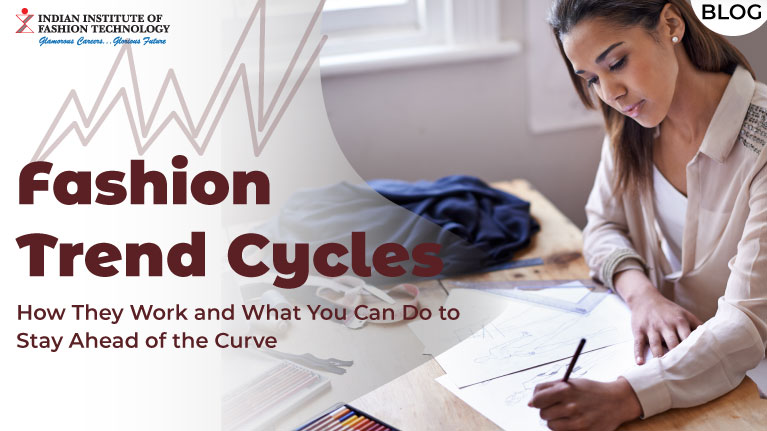
What comes around, goes around – Similarly, trends come and go in the fashion industry. While some of them stick around for a while, others perish after just a season or two.
So, what makes certain trends take off while others fall flat? We will try and figure out that mystery in this blog post.
If you’re in the fashion industry, you already know how important it is to stay ahead of the curve. If you are looking to become a fashion designer, then you need to understand the importance of trends. The whole fashion industry is fueled by ever-changing trends.
That means knowing not only what’s hot right now but also what will be popular in the future. In this blog post, we’ll discuss fashion trends and how they work. We’ll give you a detailed explanation of trend cycles from inception to Obsolescence. And most importantly, we’ll teach you how to stay ahead of the curve so you can always be one step ahead of your competition!
What is a fashion trend?
A fashion trend can be defined as a style or look that becomes popular within a certain time frame. The key word here is “popular.” To qualify as a trend, there must be enough people wearing the style or look to where it’s considered mainstream.
There are two kinds of trends at play.
- Micro Trends: Trends that starts and ends in a matter of months or a few years.
- Macro Trends: Macro trends stays for a longer period of time and are mainly defined by changes in demographics and lifestyles.
How do fashion trends start?
There are a few ways that fashion trends can start. The most common is when celebrities or other public figures are seen wearing a certain style or look. This could be anything from a new hairstyle to a type of clothing that’s not typically worn.
Another way trends can start is through the fashion industry itself. This is often done by fashion designers who showcase their latest creations on the runway. If a particular style or look catches on, it could soon become a trend.
Lastly, trends can also start organically. This happens when a group of people – often young people – start wearing a certain style or look because they think it’s cool or stylish. Once word gets out, more and more people begin to wear the style or look until it eventually becomes a trend.
How do fashion trends end?
Just as there are a few ways that fashion trends can start, there are also a few ways that they can end.
The most common way trends end is simply because they run their course. This means that the style or look is no longer considered popular or fashionable. In some cases, a trend may start to go out of style after just a season or two.
Another way trends can end is when they become mainstream. This often happens when a trend becomes so popular that everyone starts wearing it. Once it becomes too common, people start to get bored of it, and the trend dies out.
Lastly, trends can also end when they’re replaced by a new trend. This often happens when a new style or look comes along that’s considered cooler or more fashionable than the old trend. The old trend quickly dies out as soon as the new trend catches on.
What are the different stages of a fashion trend?
There are four main stages of a fashion trend: inception, growth, maturity, decline, and Obsolescence. Let’s take a closer look at each stage.
Inception or Introduction: This is when a trend is first introduced. It’s typically done by celebrities, designers, or other public figures who are considered trendsetters.
Growth or Increase: This is when the trend starts to catch on and become more popular. More and more people start wearing the style or look until it eventually becomes mainstream.
Maturity or Peak: This is when the trend reaches its peak and becomes oversaturated. At this point, it’s often considered too common, and people start to get bored of it.
Decline: This is when the trend starts to die out, mainly because the trend has over-saturated the market. Let me explain this with an example. You discover an amazing song, and you can’t get enough of it; you listen to it on a loop for days, and after some time, you are so saturated with the song that you start to feel irritated by the mere intro music of that song. The same thing happens in this scenario.
Obsolescence: This is where the trend dies and is eventually replaced by a new trend. In this cycle, people will start seeing the trend as outdated or out of fashion.
What are some examples of fashion trends?
Some examples of recent fashion trends include athleisure, off-the-shoulder tops, and ripped jeans.
Athleisure is a trend that combines athletic and leisure wear. It started in the early 2010s and quickly became popular among young people.
Off-the-shoulder tops are a type of clothing that exposes the shoulders. They became popular in the summer of 2016 and are still going strong.
Ripped jeans are another example of a current fashion trend. They’ve been around for decades but have seen a resurgence in popularity in recent years.
What can you do to stay ahead of the curve?
If you want to stay ahead of the curve, there are a few things you can do.
First, pay attention to celebrities, designers, and other public figures who are considered trendsetters. If you see them wearing something new, there’s a good chance it will eventually become a trend.
Second, stay up to date on the latest fashion trends. This can be done by reading fashion magazines or blogs, watching fashion shows, or following your favorite fashionistas on social media.
Third, don’t be afraid to experiment with your own personal style. Try out new looks and trends that you think you might like. You never know – you could end up being a trendsetter yourself!
Learn how fashion trend forecasting can help you figure out upcoming trends in the fashion industry. There are a number of fashion courses that can help you out with this.
Fashion is an ever-changing industry, so it’s important to stay ahead of the curve if you want to stay stylish. By paying attention to trendsetters, staying up-to-date on the latest trends, and experimenting with your own personal style, you’ll be sure to stay ahead of the fashion curve.
Conclusion:
Fashion trend cycles are a complex phenomenon, but by understanding how they work, you can stay ahead of the curve and keep your wardrobe up to date.
Pay attention to celebrities and other public figures who are considered trendsetters, stay up-to-date on the latest fashion trends and experiment with your own personal style. By doing these things, you’ll be sure to stay ahead of the fashion curve. Thanks for reading!
There are a number of Fashion designing courses that could help you understanding about fashion trends and to learn to analyze and forecast future trends based on past & present data available. These courses will also help you in developing the skills you need to become a successful fashion designer.




Discussion